
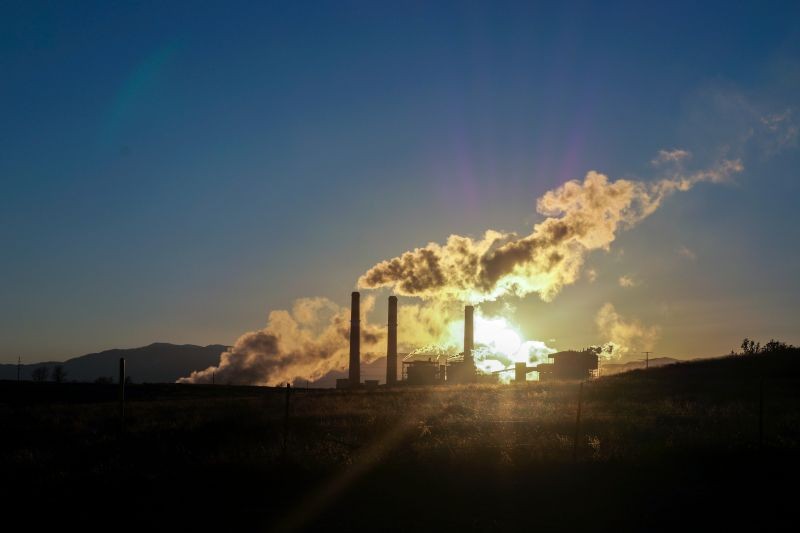
2024 is the first year to exceed 1.5°C above pre-industrial level, say scientists
2024 is the first calendar year that has reached more than 1.5°C above the pre-industrial level, as per the European Union's Copernicus Climate Change Service (C3S).
Copernicus Climate Change Service said 2024 was the warmest year on record globally.
Scientists said human-induced climate change remains the primary driver of extreme air and sea surface temperatures; while other factors, such as the El Niño Southern Oscillation (ENSO), also contributed to the unusual temperatures observed during the year.
Copernicus Climate Change said a new record high for daily global average temperature was reached on 22 July 2024, at 17.16°C.
"Each month from January to June 2024 was warmer than the corresponding month in any previous year on record. Each month from July to December, except August, was each the second warmest, after 2023, for the time of year," the body said in a statement.
In 2024, the annual average sea surface temperature (SST) over the extra-polar ocean reached a record high of 20.87°C, 0.51°C above the 1991–2020 average.
Carlo Buontempo, Director of the Copernicus Climate Change Service, said: "All of the internationally produced global temperature datasets show that 2024 was the hottest year since records began in 1850."
"Humanity is in charge of its own destiny but how we respond to the climate challenge should be based on evidence," Carlo Buontempo said.
"The future is in our hands - swift and decisive action can still alter the trajectory of our future climate," he said.
Various governments signed the Paris Agreement in 2015 whose aim was to try and prevent average temperatures exceeding 1.5C.
The climate change agreement came into force on 4 November 2016.
IBNS
Senior Staff Reporter at Northeast Herald, covering news from Tripura and Northeast India.
Related Articles

Stop taking pills without advice! PM Modi flags rising antibiotic resistance
Indian Prime Minister Narendra Modi on Sunday urged citizens to refrain from self-medicating, especially with antibiotics, during his monthly Mann Ki Baat radio address.

Climate disaster shock: Heatwaves, fires and floods cost world $120 billion in 2025 , claims report
Heatwaves, wildfires, droughts and storms caused more than $120 billion in economic losses worldwide in 2025, according to a new Christian Aid report, Counting the Cost 2025. The findings highlight the escalating financial and human toll of climate change, with fossil fuel expansion identified as a central driver of the crisis.

Breakthrough study: Scientists identify enzyme that regulates weight and cholesterol
Obesity is a global epidemic and a major cause of morbidity and mortality because it increases the risk for comorbidities, including heart disease and fatty liver disease (MASLD). Rates of these disorders have risen as the world increasingly adopts energy-dense diets and sedentary lifestyles.

Doctors flag a hidden clue: Why a stiffer colon could mean higher cancer risk?
Increased stiffness of the colon, spurred by chronic inflammation, may encourage the development and progression of early-onset colorectal cancer (CRC), a study co-led by UT Southwestern Medical Center researchers suggests.
Latest News
Big defence push! Rajnath Singh-led council clears Rs. 79,000 crore for Armed Forces

All Tea Garden workers safely rescued from Arunachal Pradesh, brought to Kailashahar

Visva-Bharati University unveils a transformational roadmap under Vice-Chancellor Dr. Probir Kumar Ghosh

Assam Rifles, Customs seize foreign cigarettes worth Rs 65 Lakh in Tripura

