
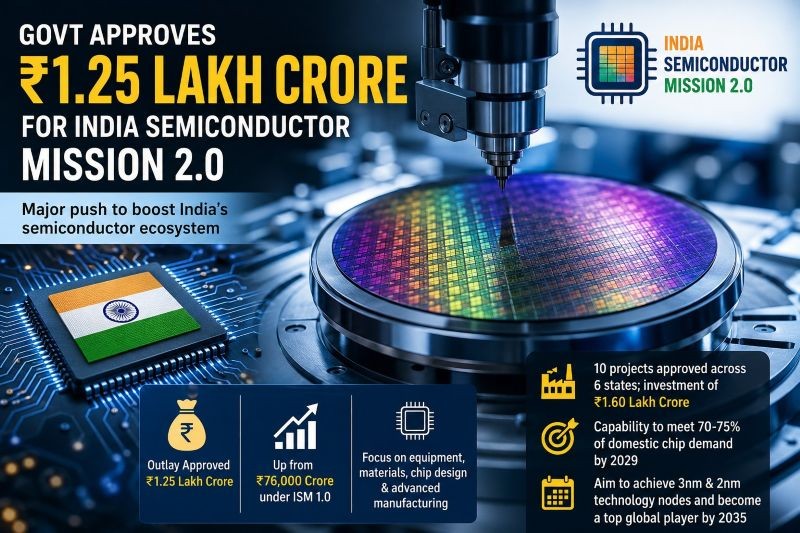
The proposal was cleared by the EFC last week and will now be placed before the Union Cabinet for final approval, sources told NDTV Profit.
The proposed outlay marks a significant increase from the Rs 76,000 crore allocated under ISM 1.0, under which the government approved 10 semiconductor facilities across chip fabrication, assembly and design, the news channel reported.
What is India Semiconductor Mission 2.0?
India Semiconductor Mission 2.0 was announced during the Union Budget presentation this year.
ISM 2.0 will focus on producing semiconductor equipment and materials in India, designing full stack Indian semiconductor intellectual property, and fortifying both domestic and global supply chains.
As per an Indian government statement published earlier, a provision of Rs. 1,000 crore has been made for ISM 2.0 for FY 2026–27, with a strong emphasis on industry led research and training centres to drive technology development and create a future ready skilled workforce.
As per industry estimates, the size of the Indian semiconductor market was about $38 Bn in 2023, $45-$50 billion in 2024-2025 and is expected to reach $100-$110 Bn by 2030, read a government statement.
The government said the foundation of the growth was laid with the approval of India Semiconductor Mission 1.0 by the Union Cabinet in December 2021.
The Mission is supported by an incentive framework of ₹76,000 crore, offering fiscal support of up to 50 per cent for silicon fabs, compound semiconductor facilities, assembly and testing units, and chip design.
As of December 2025, 10 projects with a total investment of ₹1.60 lakh crore have been approved across 6 states.
These include silicon fabrication units, silicon carbide fabs, advanced and memory packaging facilities, and specialised assembly and testing infrastructure. Together, they are shaping a resilient domestic semiconductor ecosystem.
By 2029, India is expected to achieve the capability to design and manufacture chips required for nearly 70–75 per cent of domestic applications.
Advancing on this foundation, the next phase under Semicon 2.0 will focus on advanced manufacturing, with a clearly defined roadmap to achieve 3-nanometre and 2-nanometre technology nodes. By 2035, India aims to be among the top semiconductor nations globally.