
The government on Monday reported that India's real Gross Domestic Product (GDP), or GDP at constant prices, rose to ₹81.36 lakh crore in Q1 FY 2026-27 from ₹75.46 lakh crore in the corresponding quarter of FY 2025-26, registering 7.8% growth.
The strong growth figure has been highlighted by the government as evidence of the resilience of the Indian economy despite global headwinds, including geopolitical tensions, higher energy prices and trade disruptions.
Garg questions 7.8% GDP growth
Garg has raised questions over the revision of India's GDP figures, particularly the change in the previous year's nominal GDP estimate.
He argued that the downward revision of the previous year's current-price GDP—from around ₹86 lakh crore under the earlier series to about ₹80 lakh crore under the revised series—has a significant bearing on the headline growth calculation.
Garg's calculations suggested that growth could be around 2.6% when certain figures from the earlier and revised series are compared.
His remarks have since triggered a wider debate over India's GDP methodology and the manner in which the revised figures should be interpreted.
Government rejects 2.6% calculation
Government officials, however, have disputed Garg's calculation, saying the 2.6% figure is derived by comparing numbers from two different GDP series.
The latest GDP estimates use 2022-23 as the base year, replacing the earlier 2011-12 base year. The new series also incorporates updated data sources and methodological changes, including more detailed price information.
According to government officials, the comparable figures under the new series show nominal GDP rising from ₹80 lakh crore in Q1 FY 2025-26 to ₹88.27 lakh crore in Q1 FY 2026-27, while real GDP increased from ₹75.46 lakh crore to ₹81.36 lakh crore. This produces the official 7.8% real growth rate.
The Ministry of Statistics and Programme Implementation (MoSPI) has also defended the methodology, saying the revisions reflect improvements in data sources and estimation techniques rather than an attempt to artificially boost growth.
Debate over India's economic performance
The controversy has opened a broader debate over how India's economic performance should be assessed.
While the government has pointed to the 7.8% figure as evidence of strong economic momentum despite global uncertainties, critics have questioned the impact of revisions, the GDP base-year change and the underlying assumptions used to calculate real growth.
The government has maintained that comparisons must be made within the same statistical series and that the latest estimates are based on improved methodology.
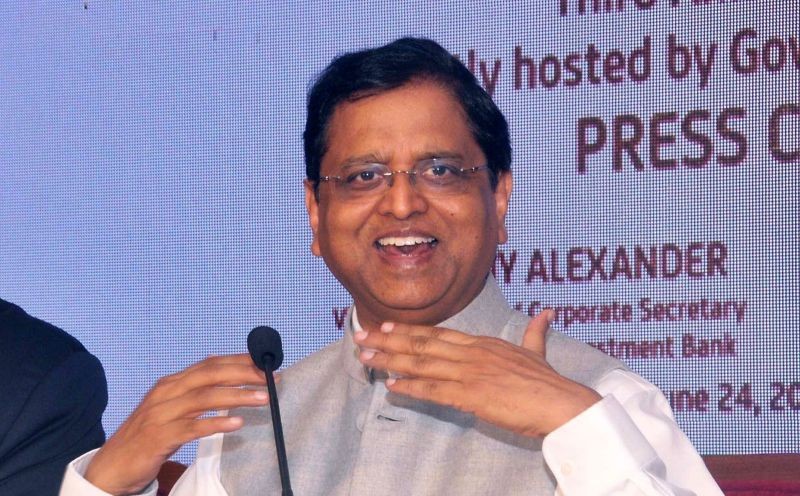
Who is Subhash Chandra Garg?
Subhash Chandra Garg is a retired 1983-batch IAS officer of the Rajasthan cadre who held several senior economic-policy positions in the Government of India.
Key positions held by Garg
- Economic Affairs Secretary, Ministry of Finance — 2017 to 2019
- Finance Secretary of India — 2019
- Secretary, Ministry of Power — 2019
- Executive Director, World Bank — 2014 to 2017
As World Bank Executive Director, Garg represented India and the constituency comprising Bangladesh, Bhutan and Sri Lanka.
Before serving in the Central government, he held several senior positions in the Rajasthan government, including Principal Secretary (Finance).
Garg took voluntary retirement from the IAS in July 2019, shortly after being shifted from the Finance Ministry to the Power Ministry.
With his latest remarks, the former Finance Secretary has become a key voice in the ongoing debate over India's revised GDP estimates and what the headline 7.8% growth figure actually signifies.