
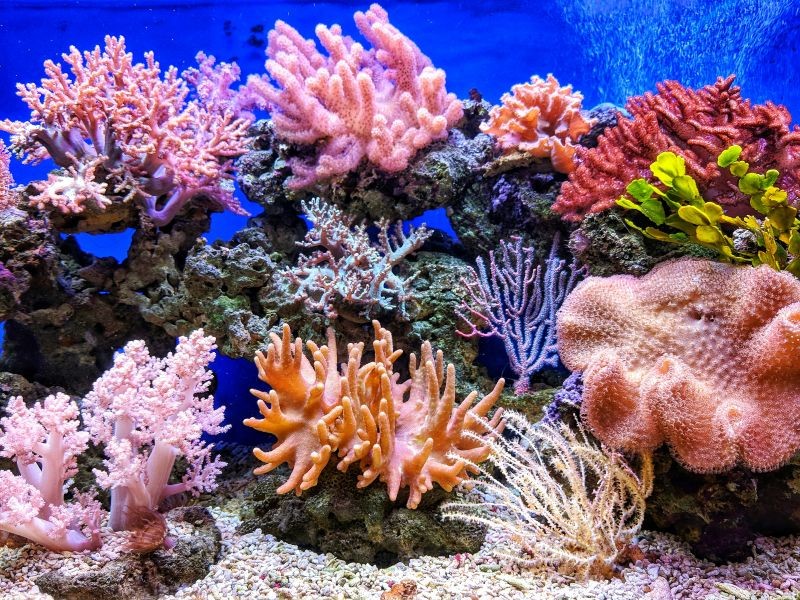
The research, published in Geophysical Research Letters, was led by Thomas DeCarlo, an assistant professor in the Department of Earth and Environmental Sciences at Tulane University School of Science and Engineering, and co-author Hannah Whitaker of The University of Western Australia.
Using four decades of data on sea-surface temperature, ocean currents and cloud cover, DeCarlo and Whitaker calibrated models that successfully reproduce every major mass bleaching event on the Great Barrier Reef since the early 1980s. They then used climate projections from 23 global models to estimate how often large-scale bleaching is likely to occur through 2100 under several emissions scenarios, reads the Tulane University website.
The study finds that even when natural “protective” factors such as clouds and currents are included, the reef is still projected to bleach during most years this century in most scenarios. That level of stress leaves corals little opportunity to reach reproductive age and recover between events.
“Over the past four decades, the Great Barrier Reef has already experienced nine mass bleaching events,” DeCarlo said. “Our projections show that if warming continues on its current track, bleaching will become a near-annual occurrence, which is essentially incompatible with a healthy, functioning reef.”
The research examines a highly optimistic scenario in which corals steadily become more tolerant of heat, based on evidence that mass bleaching now tends to occur at higher temperature thresholds than in past decades. Even then, the study finds the reef only reaches average bleaching “breaks” of four to five years under the lowest-emissions pathways — still shorter than the decade or more many reefs need to recover fully.
“There is no realistic future this century in which the Great Barrier Reef returns to its pre-bleaching state,” DeCarlo said. “But our results also show that every step toward lower emissions matters. Cutting greenhouse gas emissions can still prevent some bleaching events and reduce the overall damage to the reef.”
DeCarlo’s work on the Great Barrier Reef is part of a broader Tulane effort to understand and predict how coastal ecosystems respond to rapid environmental change. As part of that effort, his team is using a high-precision drone and laser scanning system to study water flow and small-scale variations in temperature within coral reef habitats.
They will take the system to St. Croix — the first study site — to map how water flows across reefs. By capturing these patterns of water movement, the team aims to better predict which areas of the reef will heat up the most and thus face the highest risk of bleaching.
The same system will also be used in Louisiana, where DeCarlo’s group plans to survey several restored oyster reefs. These measurements will help determine how effectively restored reefs grow and stabilize surrounding marshes, offering valuable insights for the state’s ongoing coastal restoration efforts.