
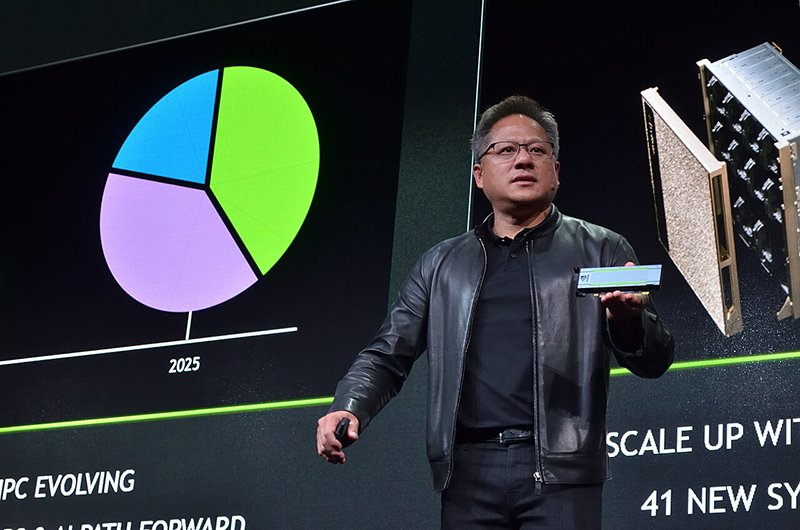
“A trillion dollars is an enormous amount of infrastructure; you have to have complete confidence that the trillion dollars you’re putting down will be utilized, would be performant, would be incredibly cost-effective and have useful life for as long as you could see,” Huang was quoted as saying by Gizmodo during the annual GPU Technology Conference in California.
That “complete confidence” is coming from a belief that demand for AI will rise exponentially, thanks to the rapid developments in agentic AI, Huang said.
Meanwhile, Nvidia on Monday announced that its latest accelerated computing platforms are unlocking a new era of space innovation, bringing AI compute to orbital data centers (ODCs), geospatial intelligence and autonomous space operations.
By bringing data-center-class performance to size-, weight- and power (SWaP)-constrained environments, NVIDIA is enabling AI applications to operate seamlessly from ground to space, and space to space, while supporting increasingly complex mission profiles.
Nvidia Space-1 Vera Rubin Module is the latest part of the Nvidia accelerated platform for space.
Compared with the Nvidia H100 GPU, the Rubin GPU on the module delivers up to 25x more AI compute for space-based inferencing, enabling next-generation compute for ODCs, advanced geospatial intelligence processing and autonomous space operations.
The Nvidia IGX Thor and NVIDIA Jetson Orin platforms deliver energy-efficient, high-performance AI inference, image sensing and accelerated data processing to enable true edge computing on orbit in a compact module.
Nvidia data center platforms, including the Nvidia RTX PRO 6000 Blackwell Server Edition GPU, deliver high-throughput, on-demand ground processing for geospatial intelligence, delivering up to 100x faster performance versus legacy CPU-based batch systems when analyzing massive imagery archives.
“Space computing, the final frontier, has arrived. As we deploy satellite constellations and explore deeper into space, intelligence must live wherever data is generated,” said Jensen Huang, founder and CEO of Nvidia. “AI processing across space and ground systems enables real-time sensing, decision-making and autonomy, transforming orbital data centers into instruments of discovery and spacecraft into self-navigating systems. With our partners, we’re extending NVIDIA beyond our planet — boldly taking intelligence where it’s never gone before.”