
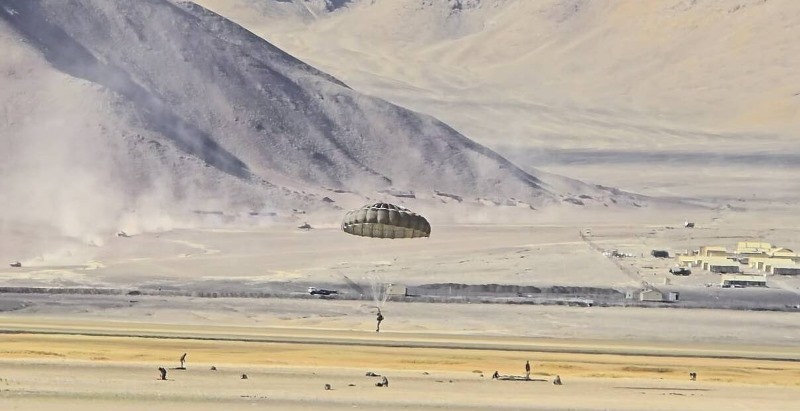
The jump was carried out from an altitude of 16,000 feet above mean sea level (AMSL), with the parachute deployed at 15,500 feet. The landing was undertaken at Nyoma (Mudh DZ), located at an altitude of 13,700 feet.
The successful trial demonstrated the efficacy and tactical employability of the indigenously developed AHAP parachute in extremely high-altitude terrain.
Designed and developed by the Aerial Delivery Research and Development Establishment (ADRDE), Agra, the AHAP is a static-line parachute system designed for the mass deployment of paratroopers.
The system has been manufactured by the Ordnance Parachute Factory (OPF), Kanpur, inspected by the Directorate General of Aeronautical Quality Assurance (DGAQA) and certified by the Centre for Military Airworthiness and Certification (CEMILAC), RCMA Kanpur.
The AHAP offers multiple deployment modes and has a wide operational altitude range of up to 18,000 feet. It also provides a low rate of descent, making it particularly suited to the tactical requirements of the Indian Defence Forces operating in high-altitude terrain.
Static-line parachute jumps at extreme altitudes are complex and inherently challenging due to factors including high opening shock and increased rates of descent.
Defence Minister Rajnath Singh congratulated the DRDO, Defence Forces, Defence Public Sector Undertakings (DPSUs) and industry partners on the successful maiden live jump of the indigenous AHAP parachute system, describing it as another significant step towards achieving Aatmanirbhar Bharat.
Defence Secretary and Secretary, Department of Defence R&D, and Chairman, DRDO, Rajesh Kumar Singh also congratulated the teams involved in the design and development of the system.