
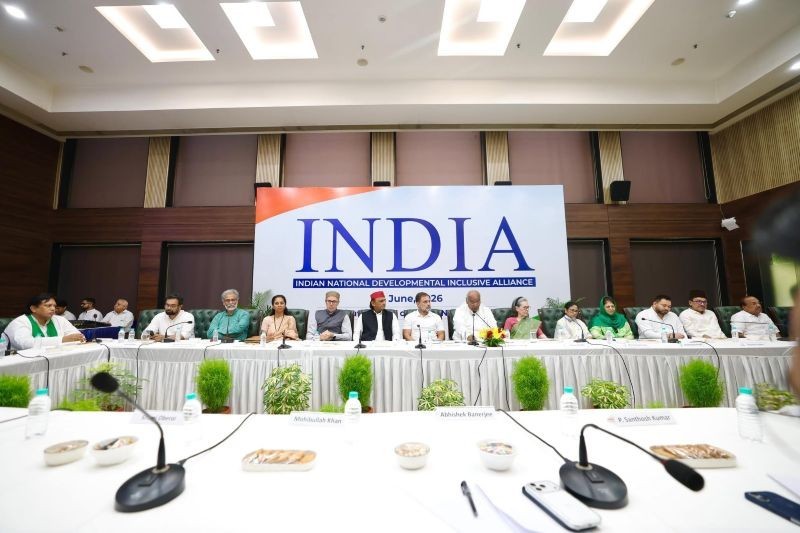
The meeting comes after the Congress Working Committee on Tuesday passed a resolution demanding the removal of Chief Election Commissioner Gyanesh Kumar and calling for Prime Minister Narendra Modi's resignation.
The Opposition alliance is also expected to discuss a proposed removal motion against Kumar and plans for a nationwide campaign, including protests and public rallies against the Election Commission, media reports said.
Congress president Mallikarjun Kharge, Rahul Gandhi and Sonia Gandhi will represent the party at the meeting. The Trinamool Congress will be represented by West Bengal Chief Minister Mamata Banerjee, Abhishek Banerjee, Kalyan Banerjee and Derek O'Brien.
Leaders of the Left parties are also expected to attend. Other participating leaders include Jharkhand Mukti Morcha chief Hemant Soren, RJD leader Tejashwi Yadav, NCP's Supriya Sule, National Conference chief Omar Abdullah and PDP leader Mehbooba Mufti. Shiv Sena (UBT) chief Uddhav Thackeray is expected to join virtually.
Samajwadi Party chief Akhilesh Yadav is not expected to attend the meeting as he is scheduled to be involved in the filing of nominations for the Rajya Sabha election. A party representative will attend on his behalf, reported NDTV.
The Aam Aadmi Party will not attend the meeting but has said it would support an Opposition move in Parliament to remove the Chief Election Commissioner. The DMK has also decided not to attend, while indicating support for the issue.
The meeting is expected to focus on the Election Commission, the SIR exercise, electoral rolls, EVMs and VVPAT, besides determining the Opposition's next course of action.
Meanwhile, the Supreme Court will next week hear the petition filed against Chief Election Commissioner Gyanesh Kumar, who is under fire over an explosive investigative report on controversial Special Intensive Revision (SIR), media reports said.
In response to the petition against Kumar, Chief Justice of India Surya Kant on Tuesday said as quoted by Bar & Bench, "List it next week."
The petition was filed by senior advocate Vikas Singh.
Singh wrote in the petition as quoted by Bar & Bench, "The purpose of having a multi-member Commission was that, and the statute says so, that it has to be a decision unanimously or by majority.
"Now, the way the Election Commission has functioned, there is serious doubt about whether there was a decision of the Election Commission for this entire exercise of special intensive revision. Because if the Commission has not taken a unanimous decision, then this... What the Court has also decided is on the basis that it is a Commission's decision. So it is a serious issue."
Investigative report on SIR
The controversy follows a report by The Indian Express that detailed differences within the three-member Election Commission involving CEC Gyanesh Kumar and Election Commissioners Sukhbir Singh Sandhu and Vivek Joshi.
According to the investigation, Sandhu and Joshi formally raised objections at least 14 times over a period of 10 months to decisions and orders concerning electoral rolls and the Special Intensive Revision (SIR). They reportedly said some decisions had been taken without their knowledge.
The objections covered changes to Form 6, access to the electoral-roll database, deletion and restoration of voter names, appeals related to electoral rolls and aspects of the ECI's internal decision-making.
The two Election Commissioners also reportedly raised concerns over what they described as the gradual centralisation of the electoral-roll database.
Electoral Registration Officers (EROs) at the constituency level have statutory responsibility for preparing and maintaining electoral rolls.
According to the investigation, Joshi called for an audit to ensure that only authorised statutory officials could alter the voter database, while Sandhu recorded complaints from state-level officials that they did not have "proper and complete access" to the relevant systems.
The report also said the two Commissioners separately wrote to Cabinet Secretary T. V. Somanathan over changes in the ECI's work allocation that they felt could further concentrate control over the IT systems handling electoral rolls.