
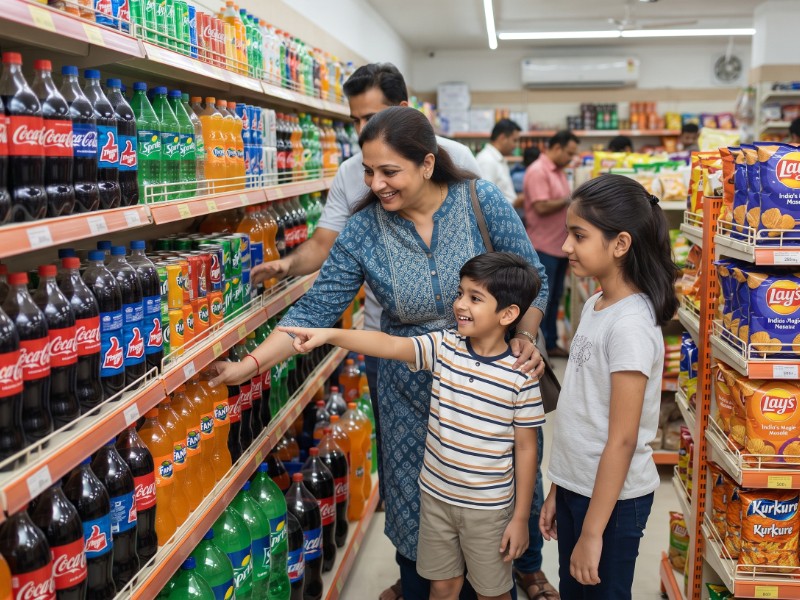
A can of Fanta sold in London contains 63 calories, while the same drink sold in India contains about three times as much sugar.
The Indian version also contains an artificial colour whose use in food products in Europe requires a prominent health warning.
In India, however, the presence of the colourant is disclosed only in small print on the back of the can.
The differences form part of a wider debate over how India should regulate packaged food and beverages, and whether consumers should receive clearer warnings about high levels of sugar, salt and fat.
According to a Reuters investigation, major food companies have pushed back against efforts by Indian regulators to introduce colour-coded nutritional warnings on the front of packaged products.
Reuters reported that its investigation was based on audio recordings, hundreds of pages of government and corporate documents, and interviews with 11 industry executives and health experts.
FSSAI drops colour-coded warning proposal
India's Food Safety and Standards Authority of India (FSSAI) said in August that it had dropped its earlier proposal for interpretive, colour-coded warnings on the front of food packaging.
Instead, the regulator proposed that companies display a black-and-white nutritional table showing the levels of sugar, fat and salt in their products.
The regulator argued that international approaches to food labelling were difficult to apply directly to India, citing differences in food preferences and the stronger flavours commonly associated with Indian cuisine.
The decision is now under scrutiny by the Supreme Court after public health activists challenged the regulator's approach.
The court had earlier directed regulators to consider stronger front-of-pack warnings and suggested examining Israel's system of red-and-green nutritional messaging.
At a hearing, judges criticised the regulator's position, saying, "the world should know that India is very much concerned about the overall health of its citizens."
The issue carries particular significance as India faces a growing burden of obesity and diet-related health concerns.
A recent study published in The Lancet estimated that 450 million Indians could be overweight or obese by 2050.
Coca-Cola executive questions effectiveness of warnings
The debate intensified during a March 19 meeting between FSSAI officials and food industry representatives.
Recordings of the meeting reviewed by Reuters show that industry executives questioned whether front-of-pack warnings would actually change consumer behaviour.
Mili Bhattacharya, a senior Coca-Cola India executive, described the belief that consumers would significantly improve their diets after seeing warning symbols as "very simplistic".
She argued that consumers who do not already read ingredient lists were unlikely to substantially change their diets simply because a symbol or icon appeared on the front of a package.
Bhattacharya also said warning labels would not prevent people from consuming sugary and salty foods and suggested they were unnecessary because doctors in India had already educated patients about foods that should be avoided.
Coca-Cola and its bottling partners, however, have voluntarily introduced traffic-light-style nutritional labels in around two dozen European markets.
Coca-Cola HBC, a Switzerland-based affiliate, describes the system on its website as providing "clear and transparent" information to consumers.
Coca-Cola and Nestle declined to comment for the Reuters report.
Food industry argues labels could mislead consumers
The Indian food industry has also raised concerns over how colour-coded warnings could affect a wide range of products.
Deepak Jolly of the Ind Food & Beverage Association (IFBA) told regulators during the March meeting that almost 80 percent of products in India's more than $100 billion packaged food and beverages market could potentially receive red warnings if such a system were introduced.
IFBA represents companies including PepsiCo.
The association told Reuters that it wanted greater clarity from regulators, arguing that current proposals could produce misleading results.
It cited the example of coconut water, which contains naturally occurring sugar but could potentially receive a "high sugar" warning under some proposed systems.
PepsiCo and other industry representatives have urged regulators to focus more heavily on portion control rather than relying on front-of-pack warnings.
India has considered different approaches to nutritional labelling since 2017, including colour-coded warnings and star ratings designed to indicate the nutritional value of packaged foods.
At present, manufacturers are required to provide ingredient lists and basic nutritional information on the back of packages.
Health activists take labelling battle to apex court
Public health advocates have argued that consumers need simpler and more visible information when buying packaged food.
Their campaign has gained momentum as packaged and processed food consumption rises alongside concerns over obesity and other diet-related health problems.
The Supreme Court intervened in February, directing regulators to consider front-of-pack warnings and specifically suggesting that India's authorities examine Israel's approach to red-and-green labels.
Following the March meeting with industry representatives, however, FSSAI moved away from interpretive labelling.
In an August submission to the Supreme Court, the regulator said it was "difficult" to match international standards on food packaging, a position that echoed arguments made by the industry.
The FSSAI declined to comment to Reuters, citing ongoing court proceedings concerning food-labelling policy.
Simone Pettigrew, head of food policy at the George Institute for Global Health in Australia, said the financial stakes gave food companies a strong incentive to resist tougher labelling requirements.
The industry was therefore incentivised "to hold out for as long as possible, not informing the Indian public about the healthiness of the foods that they're selling," Pettigrew said.
She added that lobbying by interest groups had "almost paralysed" regulators seeking to introduce stronger standards, based on her research into front-of-pack labelling systems in more than two dozen countries.
India’s growing health-conscious consumer market
The labelling debate comes as Indian consumers become increasingly conscious of diet, weight and health.
Monthly sales of weight-loss drugs that suppress appetite have increased by 400 percent since early 2025, according to market research firm Pharmarack.
Social media has also become an important platform for criticism of processed and packaged foods, with activists and influencers examining the ingredients and nutritional content of products sold in India.
One prominent campaigner is Revant Himatsingka, a former McKinsey management consultant who has built an audience of more than five million followers across YouTube and Instagram under the name Food Pharmer.
His criticism of food and beverage companies has occasionally resulted in legal disputes.
In 2023, Himatsingka posted a video questioning the amount of sugar and artificial sweetener in PepsiCo's Sting caffeine drink, which is marketed as an energy drink and is popular among young consumers in India.
PepsiCo successfully obtained a takedown order from a Delhi court, arguing that the claims in the video were false and intended to encourage a campaign against the beverage.
In July, Indian regulators ordered PepsiCo and other companies to stop using the term "energy drink" for certain products within 90 days.
PepsiCo did not respond to Reuters' questions about the matter.
Different recipes fuel consumer debate
Multinational food companies often adjust recipes according to local regulations, consumer preferences and purchasing power.
The result can be significant differences between products carrying the same brand name in different countries.
Former Mondelez executive Parul Sharma said pricing and affordability were among the main reasons why recipes could vary significantly between markets.
"Pricing and affordability are one of the biggest reasons recipes differ so much across countries," Sharma said.
In India, however, some consumers view such differences as evidence that they receive lower-quality versions of products sold elsewhere.
Himatsingka has published videos comparing Indian versions of Fanta and Nestle's KitKat with their counterparts in Europe and Australia.
Indian standard KitKat contains 4.5 percent cocoa solids, while the milk chocolate used in the Australian version contains at least 22 percent cocoa, according to the Reuters report.
Similarly, all variants of Nestle's Maggi instant noodles sold in India are made with palm oil, while many versions sold in Britain use sunflower oil.
Some Maggi packets sold in Britain are manufactured in India but carry red front-of-pack warnings indicating high salt content.
"It is the frustration of feeling cheated," Himatsingka said.
Companies begin responding to changing consumer preferences
Some signs of shifting consumer preferences are influencing some companies' product decisions.
Nestle announced in 2024 that it would begin selling sugar-free Cerelac baby food in India after activists, including Himatsingka, criticised the company for selling only versions containing added sugar in the country for decades.
Nestle has sold sugar-free Cerelac in other markets for years.