
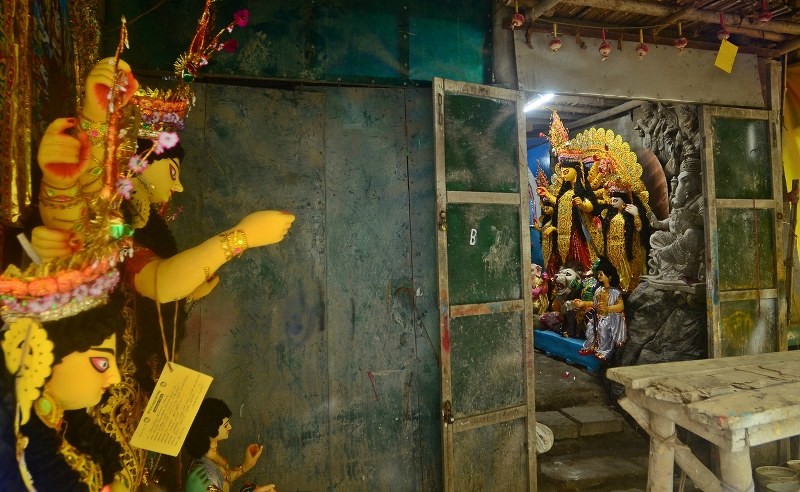
The guidelines cover a range of issues, including food around puja venues, the representation of Goddess Durga and other deities, theme-based pandals, religious rituals and idol immersion.
The recommendations have sparked a wider debate over religious customs, cultural expression and the inclusive character of Bengal's biggest festival.
The VHP has appealed to puja committees to ensure that non-vegetarian food is neither sold nor consumed inside or around puja pandals.
However, the organisation has clarified that it is not seeking a blanket ban on non-vegetarian food during Durga Puja, acknowledging that the festival in Bengal has never been strictly vegetarian.
Nirgunananda, a member of the VHP's central advisory council, said the organisation's primary concern was to preserve the sanctity of the Goddess's idol and maintain cleanliness in and around puja venues.
If non-vegetarian food is sold during the festivities, he said, it should be restricted to designated areas away from the pandal to prevent food waste from entering the vicinity of the idol.
The VHP has also indicated that it could intervene if puja committees fail to follow the suggested practices or compromise what it considers the sanctity of the idol.
VHP's guidelines on theme pandals
The VHP has also raised objections to what it considers excessive experimentation with Durga idols and theme-based pandals.
While the organisation has clarified that it is not opposed to theme pujas, it has called for the traditional form of Goddess Durga to be preserved. It has objected to what it described as the "distortion" of the deity's image in the name of creativity.
The VHP reportedly cited examples of unconventional representations, including the use of shoes and broken glass bangles, portraying Durga as a widow and using the Goddess's ten hands to represent government schemes. It has also objected to unconventional representations of other deities and Mahishasura.
The organisation has further urged puja committees to design pandals in a manner that, according to it, reflects Hindu culture and heritage.
At the same time, the VHP has maintained that it is not seeking to stop theme-based pujas altogether, saying its focus is on ensuring that the idol and religious rituals are not compromised.
Objection to 'religion is personal, festival is for all'
The VHP has also objected to the popular slogan associated with former West Bengal Chief Minister Mamata Banerjee — "Religion is personal, festival is for all."
Nirgunananda argued that people belonging to other faiths are welcome to visit Durga Puja pandals, but maintained that the responsibility for upholding Hindu religious customs rests with Hindus.
The position has drawn attention in Bengal, where several community pujas have historically involved people from different religious backgrounds.
Some puja organisers have questioned the practicality of excluding members of other communities from the organisation of the festival, pointing out that people from different backgrounds are involved in various aspects of pandal construction, decoration and preparations.
Guidelines on rituals and immersion
The VHP has also urged organisers to strictly follow prescribed religious rituals during the puja and maintain traditional practices during the immersion of idols.
The organisation has said it will recognise puja committees that conduct celebrations in accordance with religious rituals, with awards planned for selected organisers as well as priests. According to reports, the prizes will comprise items used in puja rituals rather than cash.
The guidelines have raised questions among organisers about the extent of the VHP's proposed intervention, particularly as preparations for Durga Puja are already underway and many committees have committed substantial resources to idols, themes and pandal designs.
The possibility of being asked to alter an idol, remove an element of a pandal or change a theme after construction has begun has emerged as a particular concern among organisers.
Debate over Bengal's festival culture
The VHP's recommendations have triggered a wider debate over whether religious organisations should prescribe practices for community Durga Pujas and where the line should be drawn between religious sanctity and cultural expression.
The issue is particularly significant in West Bengal, where Durga Puja is not only a religious celebration but also a major cultural and social festival, which was inscribed on the UNESCO Intangible Cultural Heritage list in 2021.
With preparations for the festival gathering pace, the VHP's guidelines have added another layer to the ongoing discussion over tradition versus creative expression, religious customs versus inclusivity, and who gets to define the character of Bengal's Durga Puja.