
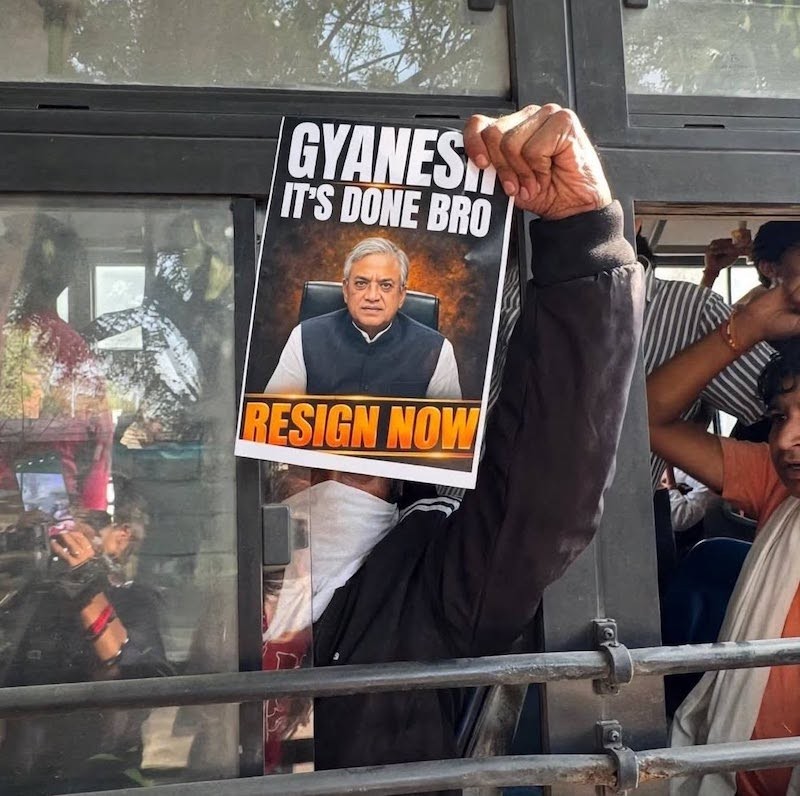
UN Human Rights Office spokesperson Thameen Al-Kheetan said in a statement, “We are concerned by reports of mass detentions in India of demonstrators, protest leaders, members of civil society organisations, lawyers and journalists, before and during today’s large-scale demonstrations in Delhi.”
The statement called on Indian authorities to respect the right to peaceful assembly, stressing that restrictions on peaceful protests must meet strict tests of necessity and proportionality.
Detained In Delhi, Mamata Banerjee Turns Prison Van Into A Protest Stage, Sings ‘Jago Durga’ #mamatabanerjee #CJProtest https://t.co/N1M8FVMlO2
— India Blooms (@indiablooms) October 10, 2026
The UN body also urged law enforcement agencies to exercise the utmost restraint while dealing with peaceful demonstrators, in accordance with India's democratic traditions and human rights obligations.
“All those arbitrarily detained must be immediately and unconditionally released,” the statement said.
Thousands detained as Delhi Police steps up crackdown
More than 2,000 people had been detained in Delhi by Saturday afternoon as police mounted a sweeping security operation to prevent a planned Cockroach Janta Party (CJP) demonstration at Jantar Mantar. West Bengal Chief Minister Mamata Banerjee, AAP leader Arvind Kejriwal and several other prominent opposition figures were among those detained.
The Indian Express reported that around 6,000 people had been detained across the capital by 2.49 pm, while Reuters separately reported that the number exceeded 2,000. The figures were higher than an earlier estimate of more than 1,500, indicating that the scale of the police operation expanded through the day. However, the final cumulative number of detentions remained unclear.
The police action began before many demonstrators could reach the proposed protest venue.
CJP founder Abhijeet Dipke and fellow leaders Saurav Das and Ashutosh Ranka were detained after their flight landed in Delhi. Other activists, content creators, lawyers and political leaders were also picked up at residences, transport hubs and along routes leading to Jantar Mantar.
The CJP had called the demonstration to demand Kumar's resignation over alleged irregularities in the Special Intensive Revision (SIR) of electoral rolls. The Election Commission and the BJP have rejected allegations of partisan manipulation, maintaining that the revision is part of the process of verifying electoral rolls.
The crackdown drew in senior opposition leaders, turning the proposed demonstration into a major political confrontation.
Mamata Banerjee, Kejriwal among opposition leaders detained
Mamata Banerjee was stopped while attempting to move towards the protest site and staged a sit-in near South Avenue. Trinamool Congress MP Saket Gokhale subsequently said that she and other party leaders had been detained outside her residence. Derek O'Brien was also named in reports of the police action.
Arvind Kejriwal was detained near Jantar Mantar, while Delhi AAP chief Saurabh Bharadwaj was among those picked up. Kerala Chief Minister Pinarayi Vijayan and other opposition leaders were also reported to have been detained.
Kejriwal later posted a video following his release.
Delhi placed under heavy security
Authorities deployed extensive security across the capital ahead of the planned gathering. According to reports, the Ministry of Home Affairs placed 221 companies of the Central Armed Police Forces, comprising around 23,000 personnel, at the disposal of Delhi Police for the period from October 8 to 12.
Barricades, vehicle checks and movement restrictions were imposed at several locations, including routes leading to central Delhi. Police also monitored transport hubs and areas where demonstrators were expected to assemble.
Jantar Mantar remained heavily secured, while groups attempting to reach the planned venue were stopped or detained. At around 1.20 pm, The Indian Express reported that no protesters had reached the site.
The security operation extended to Connaught Place, the area around Rajiv Chowk Metro station and other parts of the capital, where smaller gatherings were dispersed or demonstrators detained.
Metro, rail and internet restrictions disrupt commuters
The security measures disrupted public transport and everyday movement across Delhi. Entry and exit restrictions were imposed at Metro stations, while road diversions and vehicle checks affected traffic in central areas.
The Indian Express reported that 45 Metro stations were affected by restrictions, with entry and exit gates scheduled to remain closed until 10 pm. Reports also indicated that mobile internet services had been suspended within a four-kilometre radius of Jantar Mantar.
Rail services were affected as well, with reports of more than 250 train services being cancelled or disrupted. Northern Railway subsequently said operations were moving towards normalcy and that no further cancellations were planned.