
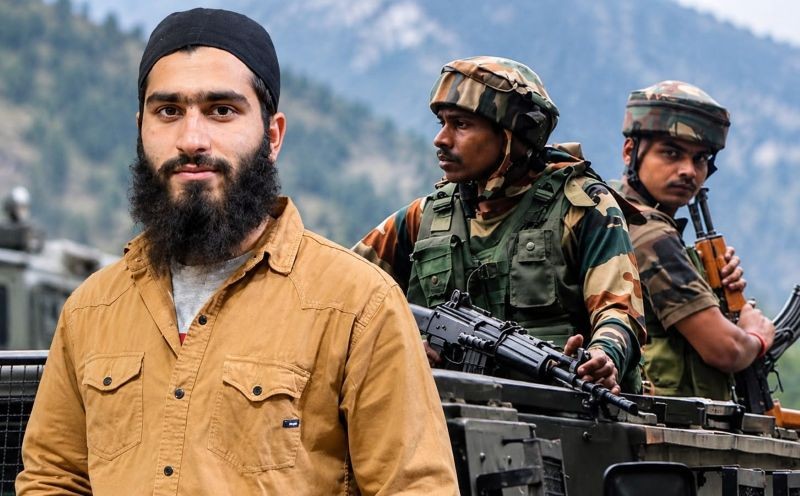
His killing in an encounter with security forces on Wednesday has drawn particular attention after Union Home Minister Amit Shah described him as Lashkar-e-Taiba’s (LeT) last known active local terrorist in Kashmir.
LATEEF KILLED!!! LeT Commander Mohd Lateef Bhat, was killed by the Indian Armed Forces. Whenever the desire to meet the 72 hoors arises in the minds of these Pakistan-based terrorists, our armed forces promptly fulfill that wish for them. Jai Hind 🇮🇳 #LateefBhat #Kashmir https://t.co/bDoYtjWj5a
— Aanand Krishna (@aanand_krishnaa) November 18, 2026
But who was Bhat, and why has his killing been described as significant for the security situation in the Valley?
From ordinary life to militancy
Bhat hailed from Khrewan Chader village in Kulgam district.
According to police records cited by media reports, he completed his schooling at Government Higher Secondary School in Ashmuji and subsequently enrolled in a bachelor’s degree course at Government Degree College in Kulgam, which he did not complete.
“I have to go to Allah. Allah is enough for me” Wanted Lashkar-e-Taiba commander Mohammad Latif Bhat refused to surrender despite repeated appeals by the Commanding Officer of 9 Rashtriya Rifles and the Kulgam SSP during an encounter in South Kashmir’s Kulgam An Army officer continued urging him to lay down his arms, but he refused. Gunfire followed
— Nabila Jamal (@nabilajamal_) November 18, 2026
He reportedly worked briefly as a glazier before disappearing from home and joining militancy in November 2025.
Police believe he was influenced by Zakir Ahmad Ganai, a Lashkar-linked operative who was later killed in a joint security operation. Bhat subsequently emerged as a key local commander associated with LeT and its alleged front organisations.
A year-long hunt and a Rs 15 lakh bounty
Bhat came under the security agencies’ radar following his appearance with Ganai in surveillance footage in Shopian in July 2026.
He was subsequently accused by police of involvement in several attacks in south Kashmir, including the killing of a policeman, Ashiq Hussain, in Anantnag on July 22, and two migrant workers in Kulgam on July 31.
He was also allegedly involved in the November 11 attack on a CRPF checkpoint in Kulgam’s Akhran area, which left three personnel injured.
With a bounty of Rs 15 lakh on his head, Bhat had become a major target for security forces.
Why did Amit Shah call him the last local LeT militant?
Following Bhat’s killing, Shah said in a post on X that coordinated efforts by Jammu and Kashmir Police, the Army, CRPF and intelligence agencies had eliminated Lashkar’s “last known active local terrorist in the valley”.
With the coordinated efforts of JKP, Indian Army, CRPF and intelligence agencies, Lashkar's last known active local terrorist in the valley, Lateef Bhat, was neutralised in an operation in Kulgam in the early morning hours today. One of his terrorist associates, Umar Nisar, was also neutralised in Kulgam, the day before. The entire operation was marked by a very high level of synergy. The nation salutes the brave Jawans of JKP, Army and CRPF and intelligence agencies.
— Amit Shah (@AmitShah) November 18, 2026
The description is significant because it distinguishes locally recruited militants from foreign operatives who infiltrate into or operate in Kashmir.
According to police records cited in media reports, Bhat was the only surviving locally active militant identified by security agencies in the Valley at the time of his killing.
It does not, however, mean that Lashkar-e-Taiba has ceased to operate in Kashmir or that the Valley is free of militancy.
Security agencies continue to track Pakistan-linked foreign militants believed to be operating in the region.
The final encounter
Bhat’s killing followed a multi-day operation in Kulgam. His associate Umar Nisar was killed in a separate encounter on November 16, while Bhat managed to escape.
Security forces eventually tracked him to Zangalpora village, where he took shelter inside a mosque.
#WATCH : The body of Lashkar-e-Taiba (LeT) terrorist Lateef Bhat, along with a weapon, has reportedly been recovered from the encounter site in Kulgam, Jammu and Kashmir. https://t.co/aMId28up6N
— upuknews (@upuknews1) November 18, 2026
According to the Army and police account, security personnel attempted to persuade him to surrender, including through a video call. He refused and was subsequently killed in the encounter.
For Shah, the operation marked a significant achievement for the security agencies. For the broader security narrative in Kashmir, the claim that no locally active LeT militant remains is a development that will merit close scrutiny.