
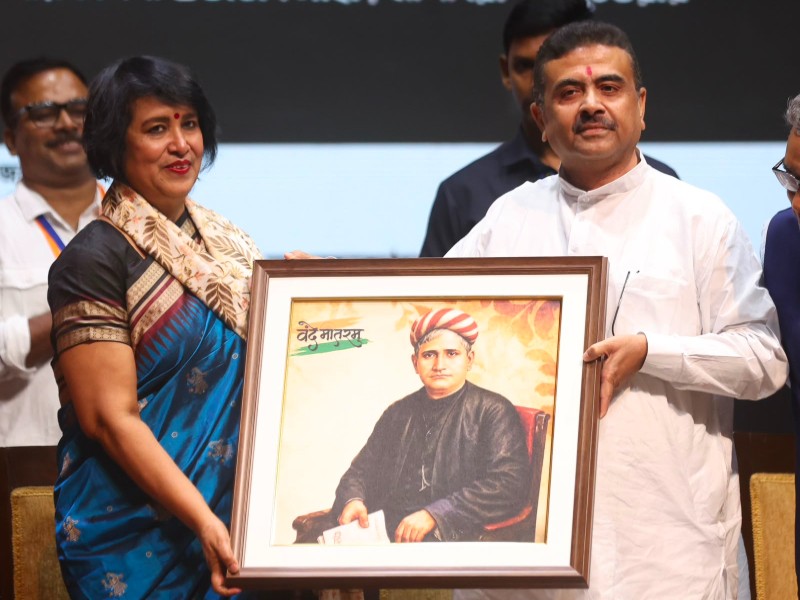
Speaking at a felicitation programme organised for Nasreen at Kolkata's Rabindra Sadan, Adhikari said ensuring her safety was the responsibility of his government and invited her to return to West Bengal as often as she wished.
"It is my duty as the Chief Minister of the state to provide you with security whenever you visit," Adhikari said during the event.
Addressing the gathering, the Chief Minister said the state government was committed to protecting freedom of expression and ensuring that every individual could exercise their right to free speech.
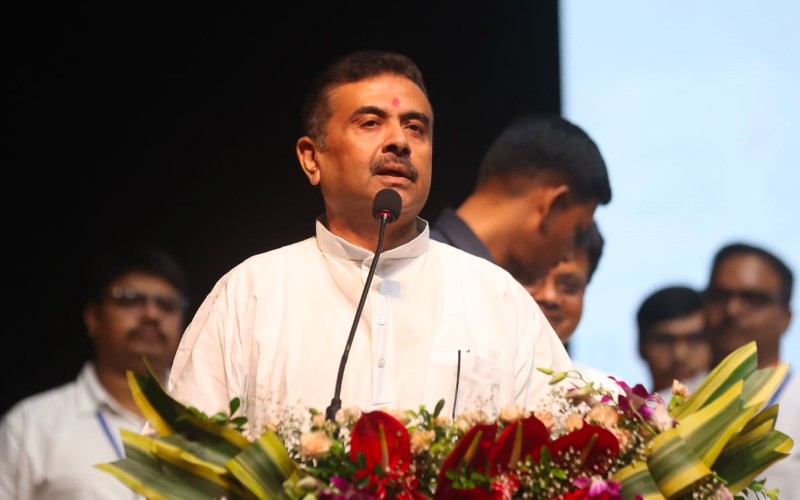 Photo: Avishek Mitra/IBNS
"Everyone has the right to exercise their freedom of speech in West Bengal under the new government," he said.
Adhikari also encouraged Nasreen to visit the state without hesitation.
"Whenever you want, you can come here as many times as you want," he said.
The Chief Minister added that "the days of threats and intimidation are over", in an apparent reference to the circumstances that forced the author to leave Kolkata in 2007.
West Bengal Chief Minister Suvendu Adhikari warmly welcomes exiled Bangladeshi author Taslima Nasrin to Kolkata during an event at Rabindra Sadan, marking her return to the city after 19 years. #SuvenduAdhikari #TaslimaNasrin #Kolkata pic.twitter.com/hDTViJMkVn
— India Blooms (@indiablooms) August 1, 2026
Taslima Nasreen's return after 19 years
Nasreen returned to Kolkata on Friday after almost 19 years away from the city.
She made her first public appearance since her return at a literary event focused on opposing religious fundamentalism.
Her visit marks a significant moment, given her long association with Kolkata and the circumstances surrounding her departure.
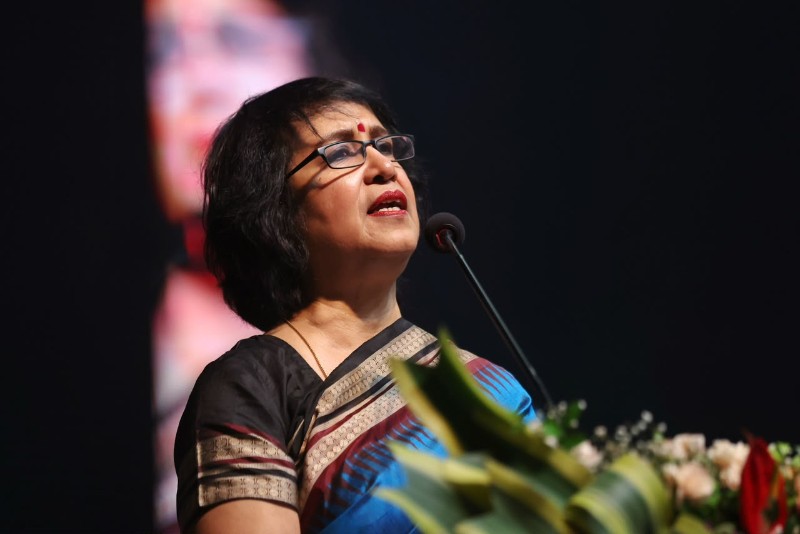 Photo: Avishek Mitra/IBNS
'Injustice can be long, but not permanent'
Addressing the gathering at Rabindra Sadan, Taslima Nasreen described her return to Kolkata after nearly two decades as an emotional homecoming and said it reaffirmed her belief that injustice, however prolonged, does not last forever.
"After coming back to Kolkata, I feel like coming back to a part of life which I left behind here," she said.
Reflecting on her years in exile, the Bangladeshi author said she hoped for a future where no writer would be forced to leave their homeland for expressing their views.
"My return proves injustice can be long, but cannot be permanent. I dream of a day when no writer would ever need to be exiled from her country," she said.
Focus on rights, not politics
Nasreen stressed that her visit was not driven by political considerations but by her long-standing commitment to women's rights and freedom of expression.
"I am not here to speak for any political party, or against any party. I am here to speak for women's rights," she said.
Recalling her years away from both Bangladesh and West Bengal, Nasreen said Europe had offered her citizenship and a home, but she had been unable to find a permanent place to live in either of the two Bengals.
"Europe has given me citizenship and a place to live, but unfortunately, I couldn't get a small place to stay in the two Bengals," she said.
The author also said that despite never being convicted by any court, she had paid a heavy personal price because of threats from fundamentalist groups.
"No court has ever punished me, but I had to pay the price because of fundamentalists," she added.
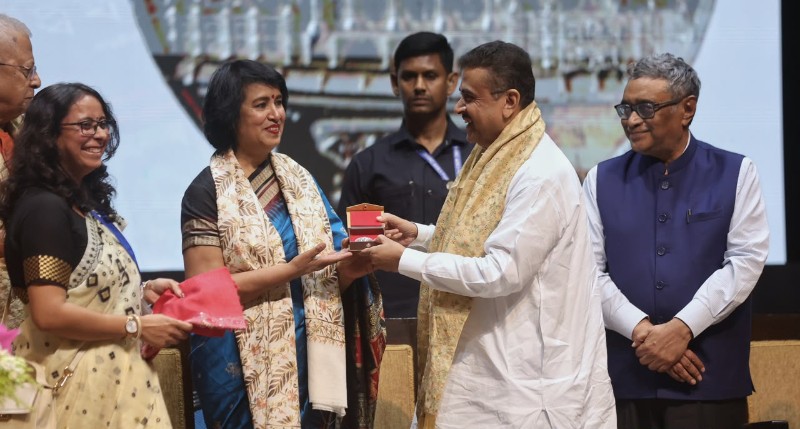 Photo: Avishek Mitra/IBNS
The exiled Bangladeshi writer lived in Kolkata between 2004 and 2007 after leaving Bangladesh amid threats over her writings.
In 2007, she was asked to leave the city by the then Left Front government following violent protests over passages in her memoir Dwikhandito (Split: A Life), which sparked controversy and demonstrations.
Her return to Kolkata comes nearly two decades after that departure, with the state government now assuring her of security and freedom to visit the city whenever she wants.