
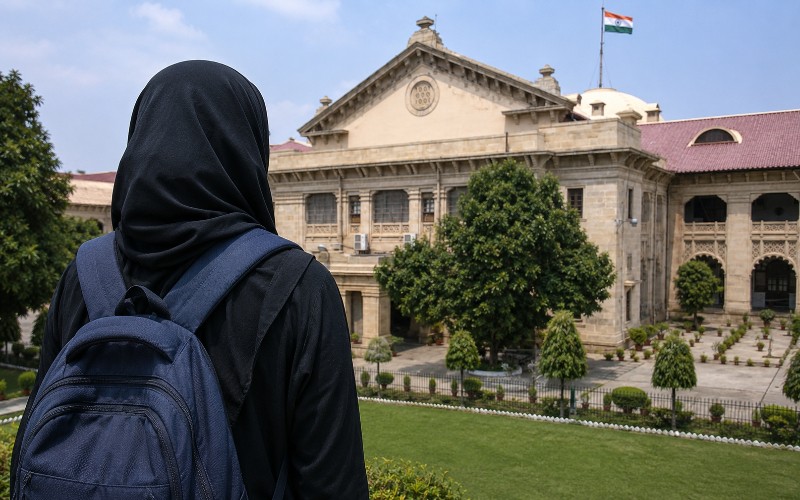
The petition was filed by the student through her mother.
The girl, who had completed her high school education, was seeking admission to Class XI at the same private school.
She told the court that she had been wearing a headscarf since Class VI and argued that wearing it formed an essential part of Islamic religious practice.
A two-judge bench comprising Justices JJ Munir and Indrajit Shukla rejected the plea in a judgment delivered on August 21.
The bench examined photographs of the petitioner from different classes and noted that she was the only girl wearing a headscarf, including among students from the same religious community.
“We have perused the photographs from various classes relating to the petitioner. Except for her, no other girl student is donning the headscarf, even those belonging to the same religious community as the petitioner,” the court observed.
The judges also rejected the petitioner's contention that wearing a headscarf was an essential religious practice under Islam.
“Wherever this issue has arisen, the high courts have been unanimous in opinion that wearing a headscarf is not an essential part of the Islamic faith for a woman to don in the absence of which faith would be jeopardised,” the court said.
The bench further noted that the petition had not established the claim through substantive material.
“It is to be noted that the assertion in the writ petition that wearing a headscarf is an essential religious practice is a bare assertion,” the court observed.
The High Court held that an unaided private educational institution has the authority to prescribe and enforce a uniform within its premises.
According to the judgment, where a dress code is applied equally to students and is intended to maintain discipline and uniformity, students cannot claim an individual right to modify it according to personal preferences.
The court said adherence to the prescribed uniform was mandatory and that the petitioner could not seek an individual exemption to add a headscarf to the uniform.
The bench observed that allowing individual students to modify or dispense with elements of a common uniform would undermine the basic purpose of having a uniform in the first place.
Court stresses equality, institutional discipline
The judgment also examined the relationship between an institution’s dress code and the rights of individual students.
The court held that where a uniform policy is fair, non-discriminatory and intended to maintain discipline and equality, the institution retains the authority to enforce its dress requirements.
Allowing students to decide individually which elements of a prescribed uniform they would follow, the court said, could effectively transfer control over institutional discipline from the school to individual students.
The ruling therefore centred on the enforcement of a common dress code rather than granting an individual student an exemption based on personal preference.
School opposes individual exemption
The private school told the court that it was a self-financed institution with a uniform policy applicable to all students.
It submitted that students from different communities studied at the institution and argued that granting an exemption to one student could affect the uniformity of the dress code and institutional discipline.
The school maintained that the prescribed uniform applied equally to its students and that there was no basis for allowing an individual alteration.
The State Government and the Central Board of Secondary Education (CBSE) also opposed the petition.