
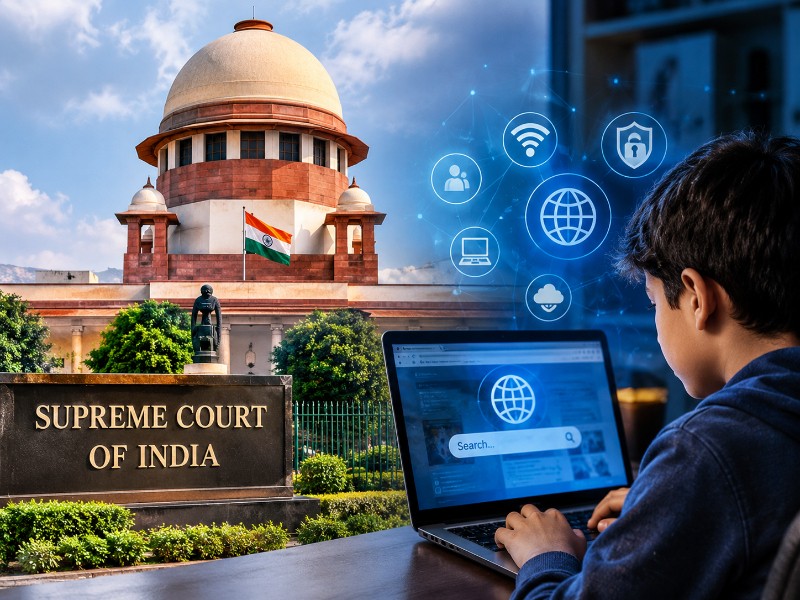
A bench comprising Justices J B Pardiwala and K V Chandran made the observations on October 15 while hearing applications filed by child rights NGO Just Rights for Children Alliance and another applicant.
The pleas raised concerns that social media platforms were failing to meet their legal obligations to report child sexual exploitation and abuse material (CSEAM) to Indian authorities.
The court emphasised that protecting children from online harm should not mean denying them their fundamental freedoms.
Instead, it called for stronger parental controls, effective child-safety features and the removal of abusive material from digital platforms.
SC affirms children's internet rights
The bench said internet access and use fall under the fundamental rights guaranteed by the Constitution.
"We have no hesitation in saying that the right to access and use the internet is a fundamental right of every individual under Article 21 read with Article 19(1)(a) of the Constitution," the court observed.
It stressed that children enjoy the same fundamental rights irrespective of their age and rejected the idea that their access to the internet should be prohibited outright.
"Our children, irrespective of their age, enjoy the same rights, and to deny the same altogether would be as absurd as saying children below a certain age do not have a conscience worth protecting or a freedom of speech worth expressing," the bench said.
The court also underlined that children's safety and freedom must be protected together.
"The safety of our children and their freedom are not at odds with each other. Our children are entitled to both," it stated.
No blanket ban, stronger safeguards
Rejecting an age-based blanket ban, the Supreme Court observed that children would not necessarily stop using the internet simply because the law prohibited them from doing so.
The bench instead called for a stronger framework to protect young users from child sexual abuse material (CSAM) and other forms of online exploitation.
It highlighted the importance of effective parental controls, child mode features on social media platforms and the prompt removal of illegal content.
The court's observations came amid concerns that abusive material continued to circulate online despite existing guidelines and obligations imposed on authorities and digital intermediaries.
It criticised what it described as a "lack of earnest initiative to protect the victims", raising questions about the continued availability and circulation of material depicting child sexual abuse.
Court flags online abuse material
The bench expressed concern over reports submitted by the applicants alleging that paid promotions of CSEAM were taking place through redirect links and websites on social media platforms.
"We are deeply saddened to note that the news reports placed before us by the applicants flagging alleged incidents of paid promotions of CSEAM on social media platforms through redirect links and websites is only one rare instance of such harmful activities being discovered and brought to light," the court observed.
It questioned how many more victims would have to suffer before stronger collective action was taken against the circulation of abusive material.
"There comes a time when we must ask ourselves, how many more victims of such harmful content must continue to suffer, before our conscience is stirred into making collective effort in the right direction," the bench added.
The court's remarks highlighted the continuing concerns surrounding the discovery, promotion and circulation of child sexual abuse material online, including through links that can direct users to external websites.
Appeal for national database
The applicants had sought uniform reporting procedures, a centralised portal and action against intermediaries that failed to comply with their legal obligations.
Addressing the concerns, the Supreme Court directed the Centre to establish a national database of digital identifiers and URLs associated with confirmed abusive material.
The database is intended to help authorities and platforms identify, detect and remove such content more effectively.
The bench also directed the Centre to frame guidelines and standard operating procedures covering perceptual hash-matching, URL listing and other technological methods for identifying and removing illegal material.
Perceptual hash-matching can help systems recognise copies or altered versions of known content without relying solely on an exact file match.
The court's proposed framework seeks to strengthen the technological processes used to identify and prevent the repeated circulation of confirmed abusive material.
Zero tolerance for exploitative content
The Supreme Court made clear that protecting children's rights must go hand in hand with preventing their exploitation through digital platforms.
"We cannot emphasise this enough, that there can be no space for non-consensual sexually exploitative and abusive material on the internet, particularly on platforms that are readily accessible to the most impressionable and vulnerable of our society," the bench said.
The proceedings focused on the responsibilities of social media companies and authorities in reporting, detecting and removing child sexual exploitation material, while ensuring that children retain their constitutional rights to access and use the internet.