
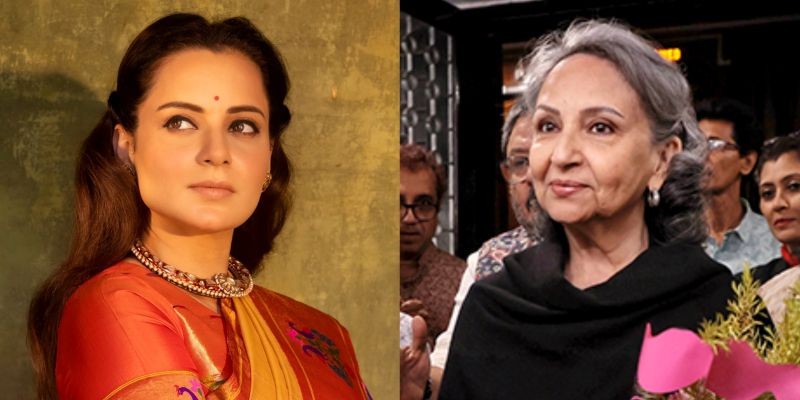
What did Sharmila Tagore say?
In a recent interview with IANS, Sharmila Tagore said she believed only the first two stanzas of Vande Mataram should be retained, arguing that people from monotheistic faiths may find it difficult to sing the remaining portions because of references to Hindu deities.
"My point of view is that here, people belonging to many religions and faiths reside, who believe in one God, a single God, not many gods.
"And in Vande Mataram, the stanza where worship is offered to many gods, if you read it, you will find that all the gods are mentioned by name. So, for those who believe in one religion, it is difficult for them to say, 'Vande Kali, Vande Durga...' It is difficult. So, if we take together and carry along people of all religions residing in India, then the first two stanzas are very good," Tagore said.
Delhi: On Vande Mataram, actress Sharmila Tagore says, "My point of view is that here, people belonging to many religions and faiths reside, who believe in one God, a single God, not many gods. And in Vande Mataram, the stanza where worship is offered to many gods, if you read… pic.twitter.com/ZVIZbUW917
— IANS (@ians_india) August 20, 2026
Kangana Ranaut hits back
Ranaut responded to the remarks in an Instagram story, sharing Tagore's interview along with a lengthy post in which she criticised the veteran actor for "reducing such a piece of art to a mere religious practice."
"I appreciate that Sharmila ji has spoken about her reservation on Vande Mataram, but I am shocked as an artist how can her views on art/poetry be so limiting and contrived," Ranaut wrote.
She argued that poetry and songs often use metaphors and imagery to convey ideas beyond their literal meanings.
‘Spirit of freedom struggle’
Ranaut said Vande Mataram represents the spirit of India's freedom struggle and argued that Bankim Chandra Chattopadhyay's work was meant to inspire people to awaken their inner strength.
"Vande Matram is the spirit of freedom struggle. Bankim Chandra ji is compelling the nation to awaken the Shakti within, how can you reduce such a great piece of art to mere religious practice," she wrote.
Ranaut also referred to Swami Vivekananda's famous call for strength and said his words were not meant literally but were intended to inspire people.
"Please come out of Hindu Muslim mindset even if we believe in one God, doctors also call power Shakti, let's embrace each other like our own, I absolutely love you and don't mind a crushing hug like you always give me," the BJP MP added.
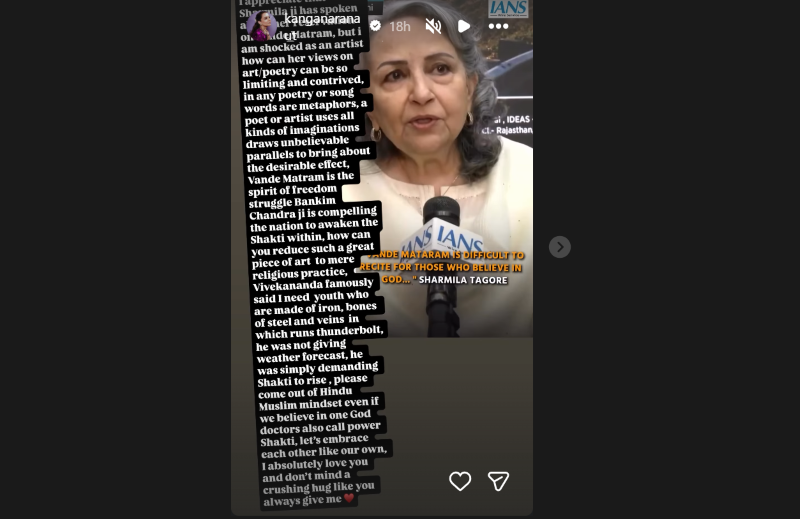 Photo: Screen-grab
Vande Mataram controversy: What is the row about?
The ongoing Vande Mataram controversy has turned into a fresh political flashpoint between the BJP and Congress, with the debate centring on whether the entire six-stanza version of the national song should be sung at official events or whether only its first two stanzas should be used.
How did the controversy begin?
The Centre had earlier issued directions encouraging the singing of all six stanzas of Vande Mataram at official events and school assemblies. The issue became particularly contentious because the later stanzas contain references to Hindu deities, while the first two stanzas focus primarily on the motherland.
The Supreme Court had earlier observed that the Centre's directive was permissive because it used the word “may”, rather than “shall”. The court indicated that a constitutional issue could arise if singing the song were made mandatory or non-compliance attracted criminal liability.
Congress chooses first two stanzas
The Congress Working Committee has decided that the party will sing only the first two stanzas of Vande Mataram, citing the historical decision taken in 1937 to use these portions.
This has triggered a sharp response from the BJP.
Union Home Minister Amit Shah accused Congress of “splitting” Vande Mataram and described its decision as an “anti-national” move. He has urged people to oppose Congress's position and said the BJP will take the issue to the masses and legislatures.
BJP vs Congress
The BJP has accused Congress of appeasement politics, while Congress leaders have questioned the BJP's interpretation of the song and its historical use.
Rajya Sabha MP Kapil Sibal hit back at Shah, asking whether BJP leaders themselves had regularly sung all six stanzas at official or private events since Independence.