
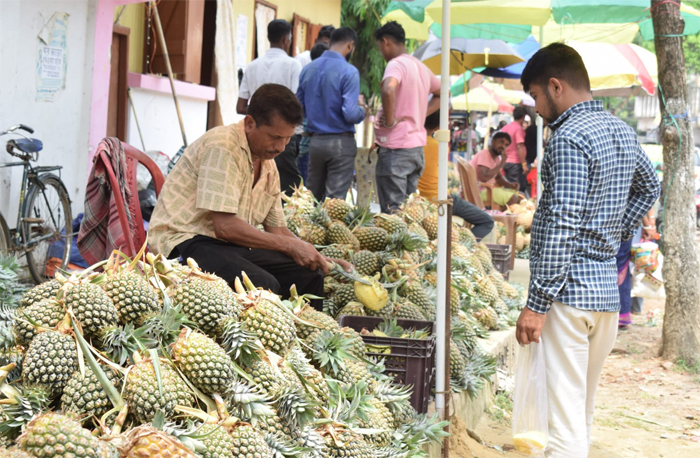
Despite achieving global recognition and earning a GI tag, Tripura’s famed Queen variety pineapple is facing an uncertain future as cultivators continue to struggle with low returns and mounting challenges in the market.
On June 7, 2018, then President of India Ram Nath Kovind declared the Queen variety pineapple as the State Fruit of Tripura during a programme in Agartala, following an initiative by then Chief Minister Biplab Kumar Deb. Since then, the fruit has gained popularity across India and abroad, with exports reaching countries such as Dubai, Oman and Qatar.
However, a visit to pineapple orchards across the state paints a grim picture for farmers. Cultivators allege that despite heavy investment and hard work, they are not receiving fair prices for their produce.
Speaking on Saturday, several pineapple growers said that although demand remains high, they often fail to recover even the production cost. At the beginning of the season, wholesalers purchase pineapples from orchards at Rs 20 to Rs 30 per piece, while the same fruits are sold in retail markets for Rs 50 to Rs 70. But when large quantities ripen simultaneously, prices collapse, leaving farmers with severe losses.
Since the formation of the BJP government, pineapple cultivation has been promoted as a profitable venture, and exports of Tripura’s pineapples have expanded significantly. Yet, growers say middlemen and brokers continue to dominate the trade. Due to the absence of direct access to major markets outside the state, farmers are forced to sell their produce cheaply to traders, who later earn substantial profits in urban and external markets.
Farmers also pointed to the lack of adequate cold storage facilities, processing units and transportation support. As pineapples are highly perishable, growers are often compelled to sell them at throwaway prices to avoid complete losses. They further claimed that government procurement mechanisms are still not strong enough to support cultivators on a regular basis.
During 2018–2020, several orchards reportedly witnessed large-scale wastage as unsold pineapples rotted due to the absence of buyers. Although the situation has improved somewhat in recent years with efforts to boost exports and improve market connectivity, many farmers continue to remain dissatisfied.
State Agriculture Minister Ratan Lal Nath had earlier stated that where pineapples once sold for merely Rs 8 to Rs 10 each, farmers are now receiving around Rs 20 to Rs 30 in many cases.
According to official estimates, Tripura currently produces nearly 1.74 lakh metric tonnes of pineapples annually across around 11,862 hectares of land. Nearly 10,000 metric tonnes are considered export-quality for international markets. Apart from Gulf countries, Tripura’s Queen Pineapple is also exported to Delhi, Assam, Karnataka, West Bengal, Odisha and Rajasthan.
Experts and cultivators believe that establishing pineapple processing industries in the state could significantly improve farmers’ earnings. Products such as pineapple fibre, threads, juice and powder could create additional value and generate employment opportunities.
Notably, former President A. P. J. Abdul Kalam had laid the foundation stone for a pineapple powder manufacturing factory at Bodhjungnagar in Agartala on October 4, 2002. However, the factory is yet to become operational.
Meanwhile, concerns are growing that pineapple cultivation in Tripura may gradually decline, much like the once-famous orange cultivation in Jampui Hills and watermelon farming in several parts of the state. As areca nut and rubber plantations are proving to be more profitable, many farmers are reportedly shifting away from pineapple cultivation.
If the trend continues, cultivators fear that Tripura’s Queen Pineapple — once declared the State Fruit and celebrated internationally — may eventually survive only in official records and memories.