
Tripura is set to make its entire healthcare delivery system fully digital by October 31, 2026, with the state government aiming to make healthcare more modern, technology-driven, integrated and patient-friendly.
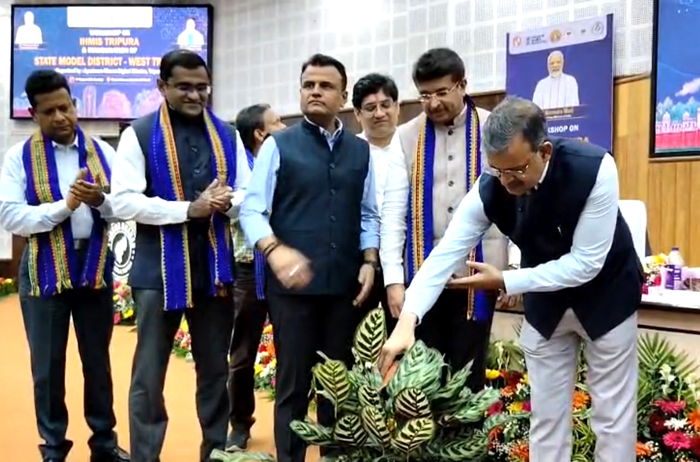
Health Secretary Kiran Gitte made the announcement while addressing a workshop on the Integrated Health Information Management System (IHMIS) and the launch of West Tripura district as a model district under the state’s digital healthcare initiative on Tuesday.
The programme was attended by National Health Authority (NHA) Chief Executive Officer Dr Sunil Kumar Barnwal,; NHA Director Dr Pankaj Kumar Arora, NHA Deputy Secretary Dr Shailesh Kumar Yadav, Tripura Health and Family Welfare Department Additional Secretary and National Health Mission (NHM) Director Saju Wahid A, and Ayushman Bharat Digital Mission (ABDM), Tripura State Mission Director Dr G. Sarat Nayak among others.
Dr Barnwal, who visited Dr Shyama Prasad Mukherjee Agartala Civil Hospital on August 10, expressed satisfaction with the hospital’s digital healthcare infrastructure, paperless system and the use of digital management in both outpatient and inpatient departments.
During the visit, he also inspected the hospital’s “Computer on Wheels” facility, which enables healthcare workers to digitally record and manage patient information directly at the bedside. Dr Barnwal said he had seen similar systems earlier in the United Kingdom and described the digital, paperless system at Agartala Civil Hospital as highly advanced.
He said Tripura could emerge as a “model digital health state” in the country if the state successfully implements its large-scale digital healthcare initiative.
According to Dr Barnwal, an integrated digital health ecosystem can be created by connecting every citizen with an Ayushman Bharat Health Account (ABHA) ID, every healthcare facility with a Health Facility Registry (HFR), every doctor with a Healthcare Professionals Registry (HPR), and all health centres with IHMIS and other ABDM-enabled software.
Speaking at the workshop, the NHA CEO said the Ayushman Bharat Digital Mission has created an important digital public infrastructure for healthcare in the country. Launched in September 2021, ABDM is approaching its fifth year and is expected to become one of the country’s major digital infrastructures.
Comparing ABDM with digital platforms such as Aadhaar, DigiLocker, e-Sign and the Unified Payments Interface (UPI), he said the mission aims to create a similarly robust digital infrastructure for the healthcare sector.
Dr Barnwal said more than 97 crore citizens across India have so far received ABHA IDs and the programme is progressing rapidly.
Health Secretary Kiran Gitte said several healthcare councils in Tripura have already adopted digital systems. The Tripura Medical Council, Tripura Pharmacy Council, Tripura Nursing Council and Tripura Allied Health Council have introduced online application facilities, digital payments and online issuance of certificates.
Gitte said the successful adoption of digital systems by healthcare councils despite limited manpower, along with the digitisation of supply-chain management for medicine procurement, demonstrates that digital transformation can be implemented across other areas of healthcare as well.
He pointed out that people are already using digital services for banking, railway and air ticket bookings, insurance premium payments and school admissions, and said healthcare services too can rapidly shift from traditional manual systems to digital platforms.
“Time is now our biggest challenge. However, our goal is clear and we will be able to complete this work,” the Health Secretary said.
He said the workshop provided Tripura with another opportunity to showcase its achievements at the national level, highlighting the state’s progress in areas including ease-of-doing-business reforms, the PM-JANMAN scheme and rural development programmes.
Gitte announced that efforts are underway to make Tripura’s healthcare system completely digital by October 31. He also said the NHA CEO would be invited back to Tripura in November to mark the achievement.
If the digital integration is completed by November, Tripura is expected to be positioned as one of India’s leading “model digital health states.”
The integrated digital system will enable patients’ health information to be accessed more easily and securely when they seek treatment at different healthcare facilities. It is expected to facilitate faster access to previous medical records, ensure continuity of treatment and enable healthcare providers to offer services more effectively according to patients’ needs.
The state already has more than 32 lakh ABHA IDs, providing a strong foundation for its digital health infrastructure.
The programme also highlighted the achievements of Ayushman Bharat–Pradhan Mantri Jan Arogya Yojana (AB-PMJAY) and Chief Minister Jan Arogya Yojana (CMJAY), which have expanded access to cashless healthcare for eligible beneficiaries while providing financial protection against medical expenses.
As of June 30, 2026, more than 16.6 lakh Ayushman cards had been issued under PM-JAY in Tripura. More than 5.7 lakh beneficiaries had availed themselves of cashless treatment, while claims worth over ₹307 crore had been settled by hospitals.
Notably, 9,283 beneficiaries had also received cashless treatment at empanelled hospitals outside Tripura.
Under CMJAY, more than 6.3 lakh Ayushman cards have been issued, with over 92,000 beneficiaries receiving cashless treatment and claims worth more than ₹50 crore being settled. A total of 2,218 beneficiaries have availed themselves of cashless treatment at empanelled hospitals outside the state under CMJAY.
During the programme, distinguished guests interacted with four beneficiaries who had received cashless treatment for major surgeries under PM-JAY and CMJAY. The beneficiaries expressed gratitude for receiving quality, cashless treatment during difficult circumstances and thanked Prime Minister Narendra Modi and Tripura Chief Minister Dr Manik Saha for the healthcare initiatives.
The programme concluded with a reaffirmation of the collective commitment to building a digitally empowered Tripura, with technology being positioned as a key instrument for delivering inclusive, efficient and people-centric healthcare services.