
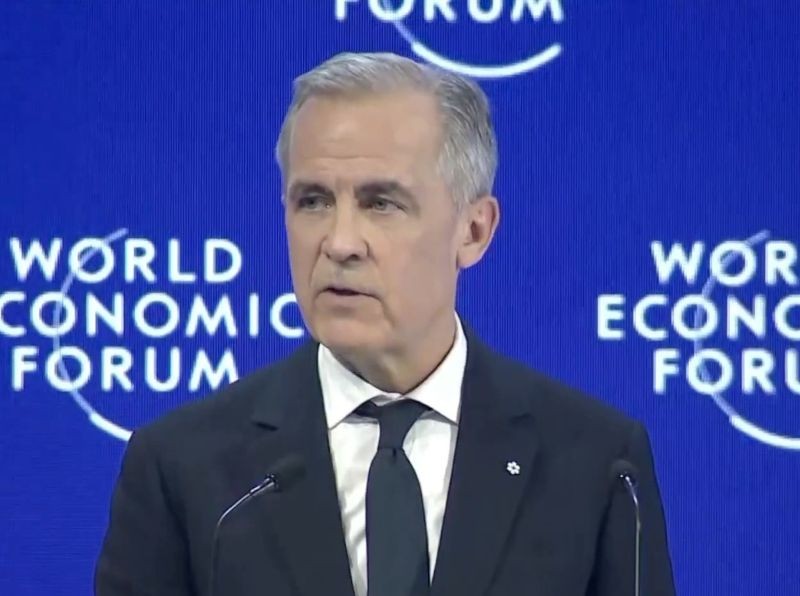
In a wide-ranging address, Carney argued that the predictable post-war system dominated by American leadership was no longer viable.
“The strong do what they can, and the weak suffer what they must,” he said, describing a world where power increasingly outweighs rules. “Compliance will not buy safety.”
“The old order is not coming back. We should not mourn it,” Carney said. “Nostalgia is not a strategy.”
Though he did not name US President Donald Trump, the Canadian leader framed his remarks as a response to the geopolitical shifts accelerated by Trump’s return to office.
“We are in the midst of a rupture, not a transition,” Carney said, rejecting the notion that the world will revert to a pre-Trump status quo.
Carney acknowledged that Canada had benefited from the previous international system, including American hegemony, which he said helped deliver public goods such as open sea lanes, financial stability, collective security and dispute-resolution mechanisms. But he warned that a new reality has taken hold.
In an era of great power rivalry, Canada is choosing to be principled and pragmatic. To name reality, to act together, and to build what we claim to believe in. pic.twitter.com/ytZKt6sRyw
— Mark Carney (@MarkJCarney) January 20, 2026
“Call it what it is: a system of intensifying great power rivalry where the most powerful pursue their interests using economic integration as coercion,” he said.
Call to middle powers
Carney urged middle powers to reject appeasement and act collectively in the face of growing geopolitical pressure. “If we’re not at the table, we’re on the menu,” he said, warning that countries like Canada lack the scale and leverage to confront major powers alone.
“Great powers can afford, for now, to go it alone. They have the market size, the military capacity, and the leverage to dictate terms. Middle powers do not,” he said.
In a pointed rebuke to Washington, Carney said Canada “stands firmly” with Greenland and Denmark following President Trump’s renewed assertion that US control of the autonomous Danish territory is inevitable.
“Canada fully supports Greenland and Denmark’s unique right to determine Greenland’s future,” Carney told the forum.
Carney’s address drew a standing ovation from political leaders, financiers and diplomats gathered in Davos.
Without explicitly naming Trump, he voiced concern that the United States is increasingly willing to dismantle the “architecture of collective problem-solving” that has shaped global governance for nearly eight decades.
Canada’s Globe and Mail, citing senior government officials, reported that Ottawa has begun exploring unconventional defence strategies in response to mounting tensions with Washington.
According to the report, Canadian planners have examined insurgency-style resistance models, similar to those used in Afghanistan against Soviet and later US forces, acknowledging that conventional resistance would be overwhelmed within days in a hypothetical invasion scenario.
Since Trump’s re-election in 2024, he has repeatedly referred to Canada as a potential “51st state,” though such rhetoric had subsided in recent months.
It resurfaced overnight when Trump shared an image on social media depicting Canada and Venezuela covered by the US flag, implying full American control.
Carney’s speech underscored a growing unease among US allies and signalled a more assertive Canadian posture in an increasingly fractured global order.