
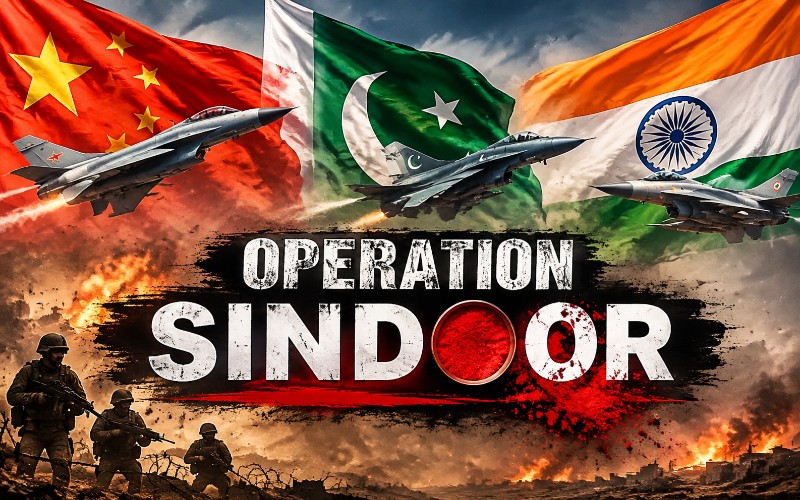
The US-China Economic and Security Review Commission, in its annual report to the US Congress, said Beijing was pursuing a coordinated approach to limit India’s rise through military pressure along the border, support for Pakistan and restrictions on critical industrial supplies.
The panel described India as an important power in the Asian balance of power and a potential alternative to China in global manufacturing and supply chains.
It called on Washington to strengthen intelligence, maritime and industrial cooperation with New Delhi to counter Beijing’s expanding influence.
US panel highlights India’s strategic importance
The commission identified India as one of the few countries outside the US alliance system with the economic and military capacity to influence the long-term balance of power in Asia.
“India is one of the few powers outside the US alliance system with the scale to materially affect the long-term competition with China,” the report said.
It added that Beijing recognised India's strategic importance and was taking steps to restrict its emergence across several areas.
“China understands this, and it is actively working to suppress India's rise across multiple domains,” the panel stated.
The report also highlighted India's potential to provide an alternative to Chinese manufacturing and supply chains, making closer cooperation between Washington and New Delhi increasingly significant in the broader strategic competition with Beijing.
China’s support for Pakistan during Op Sindoor
The three-day military confrontation between India and Pakistan in May 2025 received particular attention in the report.
According to the commission, the conflict demonstrated how China could strengthen its long-standing partner, Pakistan, during a military crisis without directly participating in the fighting.
“China's evolving military partnership with Pakistan has made a two-front contingency an increasingly critical concern for India,” the report said.
China publicly acknowledged earlier this year, for the first time, that it had provided on-site technical assistance to Pakistan during Operation Sindoor.
In an interview with a Chinese state broadcaster, engineer Zhang Heng said he was part of a team that supported the Pakistan Air Force (PAF) during the hostilities.
He said the assistance aimed to ensure that “their equipment” could “truly perform at its full combat potential”.
His comments referred to the Chinese-made J-10CE fighter aircraft operated by the PAF.
Lieutenant General Rahul Singh had previously disclosed that China supplied Pakistan with “real-time inputs” about Indian military deployments during the conflict.
Although Beijing and Islamabad have maintained close defence ties for years, the involvement of Chinese engineers in providing technical assistance during the operation pointed to a deeper level of military integration.
“The May 2025 conflict demonstrated how China could strengthen Pakistan during a crisis without Beijing entering the fighting directly, adding to India's concerns about how a future conflict with Pakistan could develop,” the US commission observed.
Border pressure and Indian Ocean expansion
Beyond its military partnership with Pakistan, the report warned that China was continuing to strengthen its military presence along the disputed India-China border and expand its strategic activities in the Indian Ocean.
The commission said Beijing understood India's importance in the increasingly contested maritime region and was extending its naval presence and surveillance activities.
India and China reached an agreement in 2024 to end their four-year military standoff in eastern Ladakh.
However, tensions have persisted along the border in Arunachal Pradesh.
Last month, the chief of the Indo-Tibetan Border Police (ITBP) acknowledged that confrontations with Chinese troops continued at several locations along the Arunachal Pradesh frontier.
The developments have added uncertainty to bilateral relations, despite efforts by both countries to restore ties following the Ladakh disengagement agreement.
The US report also pointed to China's continued development of airfields, railway networks and logistical infrastructure near the Line of Actual Control (LAC).
These facilities, it said, were strengthening Beijing's ability to rapidly mobilise troops and military resources along the frontier.
China’s industrial controls raise concerns
The commission identified China's economic influence as another major instrument through which Beijing could constrain India's strategic and industrial ambitions.
It said China's control over critical industrial inputs, technology and technical expertise was helping it protect its manufacturing advantage while making it harder for Indian companies to develop competing capabilities.
“China has restricted exports of key inputs and products to India to exert economic pressure, recalled engineers and withheld equipment to slow India's electronics manufacturing,” the report said.
The panel also highlighted China's pricing practices in the pharmaceutical sector, arguing that lower prices for essential inputs were making it difficult for new Indian manufacturing facilities to compete with established Chinese suppliers.
By reducing the cost of chemicals and raw materials used in medicine production, Chinese companies can offer more competitive prices, placing pressure on Indian manufacturers attempting to expand domestic production.
The commission further warned that Chinese export controls on battery technology could slow India's efforts to develop its clean energy manufacturing capabilities.
India expands domestic manufacturing, defence cooperation
The report acknowledged that India was responding to these pressures by modernising its armed forces, expanding domestic manufacturing and limiting Chinese participation in strategically sensitive sectors.
“New Delhi is modernising its military, building domestic manufacturing capacity, restricting Chinese involvement in sensitive sectors, and expanding cooperation with the United States and other partners,” the commission noted.
However, the panel cautioned that India's efforts to reduce dependence on Chinese industrial supplies would take considerable time and investment.
Much of India's industrial expansion continues to rely on Chinese machinery, components and other essential inputs, creating difficulties for efforts to establish independent domestic supplier networks.
“India's efforts to build domestic supplier networks will require substantial capital, technology, and time,” the report said.
Against this backdrop, the commission urged Washington to deepen its strategic engagement with New Delhi, particularly in advanced defence technologies, industrial supply chains and maritime cooperation.
The recommendations reflect the panel's assessment that India's economic and military capabilities make it an important partner for the United States in addressing China's growing influence across Asia.