
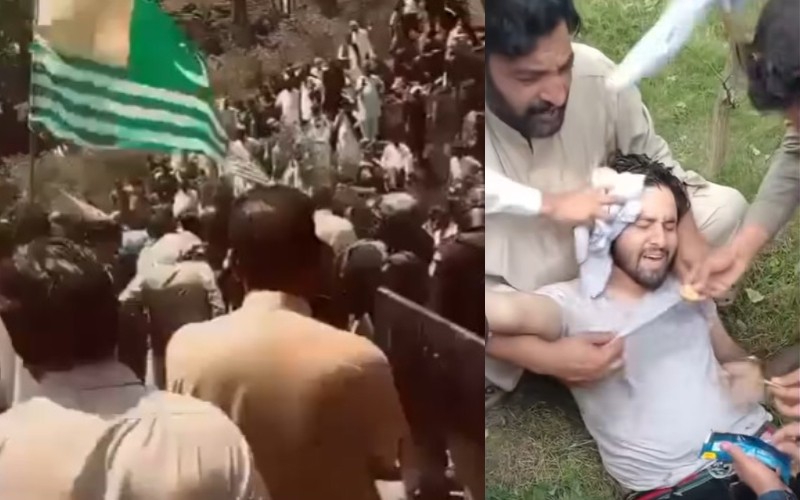
The violence erupted near Rawalakot's New Bus Terminal following a security crackdown on civilians, adding to mounting unrest in the territory.
Among those killed in the Baloch Sadhunati district were Zahid Mughal, Zafar Mughal, Arsalan Akbar and Wajid Hayat, who died near the Matial Mira Bus Terminal in Rawalakot.
The latest incident has intensified concerns over the security situation in Pakistan-occupied Kashmir, where protests and public discontent have continued to grow.
PoK protesters demonstrate outside White House
A day before the clashes, members of the Pakistan-occupied Kashmir diaspora in the United States staged a demonstration outside the White House in Washington, calling for international attention to what they described as a worsening humanitarian situation in the region.
Nearly 100 demonstrators, including women, children and community representatives, participated in the protest.
The protesters demanded the withdrawal of Pakistani military forces from civilian areas across Pakistan-occupied Kashmir.
They urged the international community to respond to what they alleged was the use of lethal force against unarmed civilians.
They also highlighted an extended internet shutdown, claiming that nearly four million residents had been cut off from communication with the outside world.
The demonstrators further appealed for humanitarian assistance and called for the Line of Control (LoC) to be opened through the Poonch and Doda sectors to facilitate relief for affected communities.
Some protesters also appealed to India to intervene to help save lives and support humanitarian efforts.
Economic and humanitarian challenges persist
Beyond the recent violence, residents of Pakistan-occupied Kashmir continue to face significant economic hardship.
According to a 2025 study published in Nature, around 66 percent of the population depends on agriculture and livestock for their livelihoods.
The study reported that more than 57 percent of households experience food insecurity, while nearly 29 percent of residents are undernourished—higher than Pakistan's national average of 19.9 percent.
The report also found that food insecurity affects as many as 90 percent of households in the mountainous areas of the region.
Healthcare indicators also remain concerning.
Pakistan's Voluntary National Review Report states that 39 percent of children under the age of five suffer from stunted growth, while the maternal mortality ratio stands at 104 deaths for every 100,000 live births.
India criticises Pakistan over crackdown
India's Ministry of External Affairs (MEA) on Tuesday criticised Pakistan over the developments in Pakistan-occupied Kashmir, linking the ongoing protests to what it described as decades of administrative oppression.
MEA spokesperson Randhir Jaiswal said, "The ongoing protests in PoJK are a direct consequence of Pakistan's decades-long systemic exploitation, denial of fundamental rights, and administrative oppression in areas under its illegal and forcible occupation."
He further accused Pakistan of responding to public grievances through force rather than dialogue.
"Rather than addressing the legitimate grievances of the local populace, the Pakistani state has responded with extreme police brutality, including against helpless women and children, blocking essential supplies, including food and medicine, enforcing internet blackouts, and deploying lethal force against unarmed civilians, which has resulted in tragic fatalities," Jaiswal said.
India also urged the international community to hold Pakistan accountable for its actions against civilians in Pakistan-occupied Kashmir.