
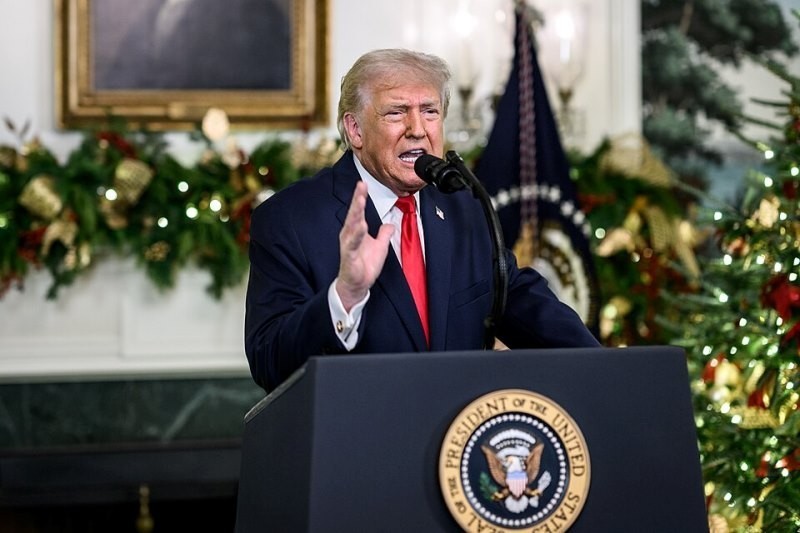
Speaking to reporters at his Florida residence on Saturday, Trump claimed that the US had already destroyed Iran's nuclear capabilities but had a few remaining targets to address.
"We've knocked out their nuclear. We still have to take care of, I would say one or two sites, but we can do that in 10 minutes," Trump said.
He specifically mentioned Pickaxe Mountain, a suspected underground nuclear facility linked to Iran's nuclear programme, suggesting that it could be among the remaining targets.
"You probably could look at Pickaxe Mountain, and you have to take care of that. We can do that all very quickly," he added.
Trump dodges question on possible Iran attack this week
Asked whether the United States could launch another attack on Iran as early as this week, Trump refused to disclose his plans.
"Why would you ask such a stupid question? Let's say I did - would I tell you?" he responded.
Despite the possibility of renewed military action, Trump maintained that diplomatic negotiations with Tehran were progressing.
"Going fine but you know they're not very reliable," he said, referring to the ongoing discussions with Iran.
Iran's Supreme Leader Mojtaba Khamenei warns of immediate retaliation
Trump's remarks came shortly after Iran's Supreme Leader Mojtaba Khamenei issued a strong warning to Washington and Tel Aviv, threatening an immediate response to any attack.
Khamenei, who has not appeared publicly since before taking over as Iran's supreme leader in March following the killing of his father, Ayatollah Ali Khamenei, in US-Israeli strikes, addressed senior military commanders.
"Any level or type of threat must be met with an immediate, impactful and geographically unrestricted response," he said, according to an official statement.
He also directed military commanders to update Iran's target list to include "all types of tangible and intangible assets belonging to the American-Zionist enemy".
The meeting was reportedly the first time Khamenei had met senior Iranian military officials since assuming the country's top leadership position.
Will Trump attack Iran after US midterm elections?
Trump has increasingly hinted at the possibility of renewed military action against Iran after the US midterm elections scheduled for November 3.
Last week, referring to the US military operation against Iran, dubbed 'Epic Fury', Trump suggested Washington could launch another round of attacks.
'We may do another little Epic Fury," he said.
The Wall Street Journal reported on Wednesday that Washington had asked several Gulf Arab countries to prepare for a possible "short, intense military campaign" against Iran following the US midterm elections.
Citing people familiar with the discussions, the newspaper said Trump had not yet made a final decision on launching another offensive.
US Secretary of State Marco Rubio also addressed the possibility of renewed military action on Saturday, saying Washington retained the capability to achieve its military objectives if required.
"We can achieve military objectives if we seek to," Rubio said, while stressing that Trump had not taken a decision on fresh strikes.
Rubio also accused Tehran of openly targeting commercial vessels in the region.
How the US-Israel war with Iran Began
The conflict began on February 28, when the United States and Israel launched joint military strikes against Iran, killing Supreme Leader Ayatollah Ali Khamenei and several senior military commanders.
Tehran retaliated by attacking American military bases across the Middle East and shutting down the strategically important Strait of Hormuz, a crucial global energy shipping route.
The disruption sent oil prices soaring worldwide.
On June 17, Trump and Iranian President Masoud Pezeshkian signed a 14-point agreement aimed at ending the conflict.
The deal called for an immediate cessation of military operations, including in Lebanon, and committed both sides to negotiating a comprehensive agreement within 60 days.
However, Trump declared the agreement "over" on July 8. Iran suspended the memorandum of understanding a week later, accusing Washington of violating its commitments.
Since then, Trump has repeatedly maintained that he is in no hurry to reach a fresh agreement with Tehran.
Meanwhile, Israeli Prime Minister Benjamin Netanyahu has also intensified his rhetoric against Iran, repeatedly calling for an end to the country's clerical regime following two major bombing campaigns since last year.
With Washington signalling its military readiness and Tehran threatening retaliation, the possibility of renewed confrontation has once again raised tensions across the Middle East.