
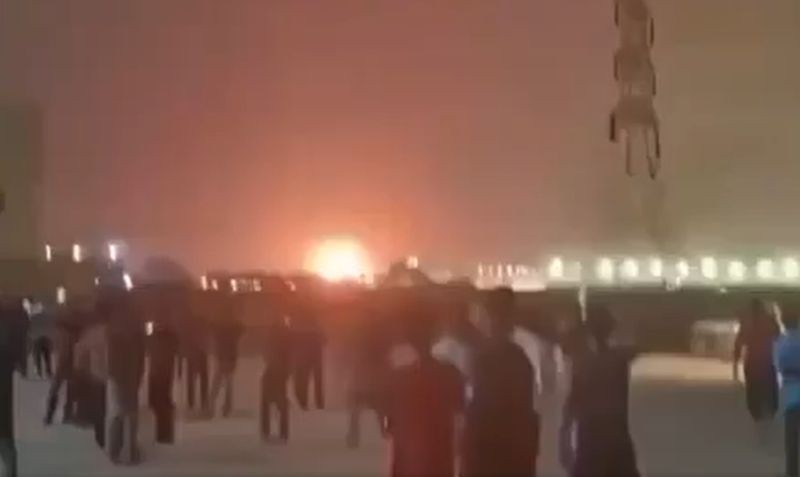
The attack marks a major escalation in the ongoing conflict involving Iran, which has increasingly targeted critical energy infrastructure across the Gulf in retaliation for US-Israeli strikes. Qatar, one of the world’s top LNG exporters alongside the United States, Australia, and Russia, has now seen repeated disruptions to its gas output.
Earlier this month, state-owned QatarEnergy had already suspended operations following missile strikes on gas fields—reportedly linked to retaliation for an Israeli attack on Iran’s South Pars field, part of the world’s largest natural gas reserve.
The crisis has intensified as tanker movement through the Strait of Hormuz—through which nearly 20% of the world’s oil flows—has slowed to a near standstill amid security threats.
With the conflict now in its third week, the vital shipping lane has effectively turned into a war zone, leaving over 700 cargo vessels stranded near key Middle Eastern ports. Oil and gas prices have surged sharply, raising fears of a prolonged global supply shock.
India among the worst hit
The disruption is particularly severe for India, which relies heavily on imported LNG to meet its energy needs.
India sources roughly 50% of its natural gas from global markets, and about 40% of its LNG imports come from Qatar—translating to nearly 20% of total gas consumption tied directly to Qatari supplies.
Energy economist Kirit Parikh warned that India may be forced to cut gas consumption, especially in energy-intensive sectors like power and industry.
India currently consumes around 189 MMSCMD of natural gas, of which only 97.5 MMSCMD is domestically produced.
Already, about 47.4 MMSCMD of supplies have been disrupted due to force majeure conditions, prompting state-run firms to scramble for alternative LNG cargoes.
The broader conflict has seen sustained strikes on Iranian leadership and infrastructure, alongside Tehran’s retaliatory missile and drone attacks across the region.
Beyond the immediate humanitarian toll, the war is now rapidly morphing into a global energy crisis—with ripple effects likely to be felt across economies worldwide.