
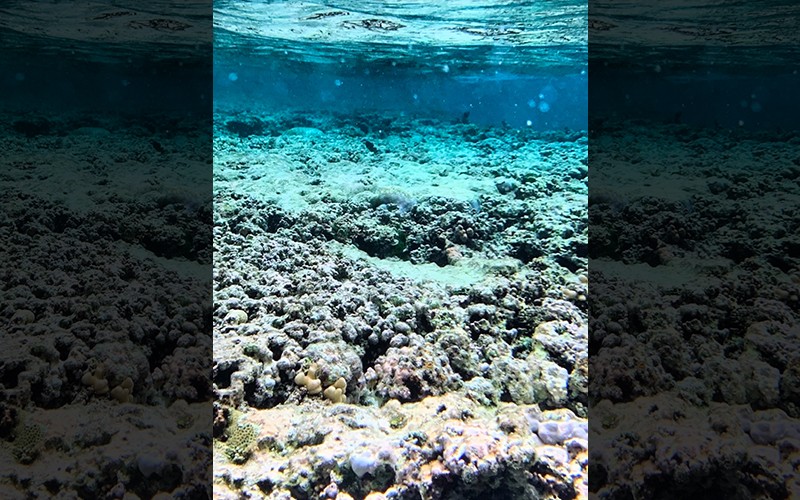
For the first time, an international team led by Smithsonian researchers estimated the extent of coral bleaching worldwide during a global marine heatwave, finding that half of the world’s reefs experienced significant damage. Another heatwave began in 2023 and is ongoing.
The analysis was published recently in Nature Communications.
It takes two partners to make a coral: a tiny animal related to a jellyfish that secretes the hard coral structure and an even tinier algae that turn sunlight into the energy the animal partner needs to live.
Bleaching occurs under heat stress, when the partnership breaks down, and the coral loses its algal symbionts—its source of energy—and turns white. Bleaching leads to reduced growth, less reproduction and even death when it is especially severe or sustained.
To obtain their estimate of the extent of reef damage from the “Third Global Coral Bleaching Event” (2014–2017), an international team from dozens of countries worldwide, led by researchers at the Smithsonian Tropical Research Institute (STRI), James Cook University in Australia and the former director of Coral Reef Watch at the U.S. National Oceanic and Atmospheric Administration (NOAA), combined satellite images of ocean water temperature from the Coral Reef Watch system with reef observations from in the water and aerial surveys around the world.
“This is the most geographically extensive analysis of coral bleaching surveys ever done,” said Sean Connolly, a senior scientist at the Smithsonian. “Nearly 200 co-authors from 143 institutions in 41 countries and territories contributed data.”
Across more than 15,000 reef surveys, 80% of reefs experienced moderate or greater bleaching, and 35% of reefs experienced moderate or greater mortality.
After calibrating the relationship between heat stress and coral damage at the surveyed sites, the team used satellite-derived heat stress measures to estimate how much bleaching occurred on reefs all around the world, including those that were not surveyed.
The team estimated that more than 50% of coral reefs worldwide suffered significant bleaching and 15% experienced significant mortality. Global decline of coral reefs affects many services reefs provide, like tourism and food supply.
“Levels of heat stress were so extreme during this event that Coral Reef Watch had to create new, higher bleaching alert levels that were not needed during prior events,” said first author C. Mark Eakin, former director of Coral Reef Watch and chief scientific advisor for the Netflix film Chasing Coral.
“Around half of reef locations affected by bleaching-level heat stress were exposed twice or more during the three-year event—often with devastating consequences,” said Scott Heron, professor of physics at James Cook University. “That included back-to-back events on Australia’s Great Barrier Reef. Three more bleaching events have happened there since. We are seeing that reefs don’t have time to recover properly before the next bleaching event occurs.”
In the past 30 years, Earth has lost 50% of its corals because the oceans absorb most of the heat people create when they burn fossil fuels. If the oceans did not absorb the heat, air temperatures would be around 50 degrees Celsius (122 degrees Fahrenheit). Data from around the world shows that the Earth is now in a Fourth Global Coral Bleaching Event.
“Our results show that the Third Global Coral Bleaching Event was by far the most severe and widespread coral bleaching event on record,” Connolly said. “And yet, reefs are currently experiencing an even more severe Fourth Event, which started in early 2023.”
“Local, regional and global economies rely heavily on the health of natural systems, such as coral reefs, but we often take them for granted,” said Joshua Tewksbury, the director of STRI. “It is vital that science communities come together, like this global team has done, to track how these critical systems are changing. Doing this well, and at scale, requires connecting geographies and combining technologies—from Earth observation satellites to in-the-water surveys that calibrate observations from space and show us the extent of the damage.”