
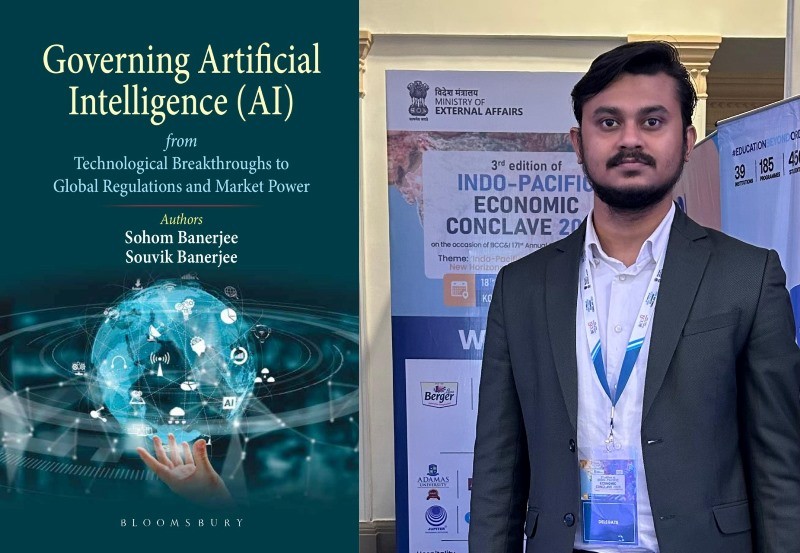
Authored by Sohom Banerjee and Dr. Souvik Banerjee, the book offers a rigorous interdisciplinary analysis of AI’s technological evolution, economic implications, regulatory challenges, and the growing concentration of market power within AI ecosystems.
Moving beyond polarised narratives of technological optimism and dystopian fear, the book positions AI as a socio-technical system embedded within political economies, institutional frameworks, and global power structures.
It traces AI’s journey from early symbolic systems to the generative AI inflection point of 2022–2025, examining how foundation models and large-scale AI systems are redefining competition, labour markets, consumer welfare, and democratic oversight.
A key contribution of the volume is its focus on AI governance in emerging economies and the Global South, with India serving as a critical case study in regulatory innovation, soft-law approaches, and institutional capacity constraints.
The book also highlights the essential role of civil society organisations and think tanks in shaping accountable and inclusive AI governance frameworks.
Structured across eight chapters, the book covers the evolution of AI, its societal and economic impacts, competition and market power dynamics, governance frameworks and global best practices, the intersection of quantum computing and AI, and the growing role of civil society and think tanks in shaping accountable AI governance.
Speaking to IBNS over an email conversation, author Sohom Banerjee said: "AI will transform society, but not in the simplistic way often portrayed. The strongest global evidence suggests that AI is primarily a task-reconfiguration technology before it becomes a job-elimination technology. Institutions such as the IMF, ILO, OECD, and WEF converge on one key insight, while AI exposure across occupations is high, full occupational displacement in the near term is comparatively limited. The dominant pattern so far is augmentation rather than wholesale automation. In my book Governing Artificial Intelligence (AI), we describe AI as a general-purpose socio-technical infrastructure, comparable to electricity or the internet, that reorganises workflows, productivity systems, and market structures. In that sense, AI does not merely 'replace' labour; it restructures how value is created."
He further said: "Historically, general-purpose technologies produce three simultaneous effects — automation of routine tasks, expansion of productivity, and the emergence of entirely new roles. Therefore, the real transformation will not be visible only in headline job counts, but in the redesign of entry-level roles, rising demand for AI-adjacent domain expertise, the creation of hybrid human–AI supervisory positions, and the expansion of regulatory and compliance professions. AI will undoubtedly reshape labour markets, but the direction and inclusiveness of that transformation will depend heavily on governance choices, institutional design, and policy frameworks — not just algorithms."
Responding to the fear around possibility of AI replacing jobs, Banerjee said: "The fear is understandable but “job apocalypse” narratives are analytically weak. The IMF estimates that around 40% of global employment is exposed to AI-driven change; however, exposure does not equal elimination. The ILO’s task-based analysis suggests that for most occupations the more likely outcome is partial automation of tasks rather than full displacement of entire jobs. The real issue, therefore, is not a single global job-loss number, but the distribution of impacts who gains, who loses, and how quickly transitions occur. In my book, I argue that AI is embedded within political economies and market power structures, if adoption is driven purely by cost minimisation without safeguards, it can deepen inequality and labour precarity."
"But if AI deployment is paired with reskilling frameworks, worker consultation, human-in-the-loop safeguards, and competition-policy enforcement, it becomes productivity-enhancing rather than exclusionary," he said.
Banerjee said the younger generation should try to position themselves around AI rather than competing with it.
"Drawing on global labour evidence and the institutional framing in my book, the most resilient strategy is to become AI-augmented, not AI-dependent. Three pillars matter most. First, AI workflow literacy, understanding how AI fits into real workflows such as drafting, analysis, coding, forecasting, and reporting because the biggest productivity gains come when AI is embedded into processes, not used casually," the author said.
He said: "Second, a domain and data combination, generic skills will increasingly commoditise, so defensibility will come from pairing AI fluency with deep sector context in areas like finance, healthcare, climate, logistics, law, or public policy. Third, governance and judgment skills, as argued in my book Governing Artificial Intelligence (AI), sustainable innovation depends on transparency, accountability, and human oversight, which makes capabilities like critical thinking, ethical reasoning, risk assessment, and policy awareness strategically valuable and far harder to automate."
He said the future labour premium will concentrate in roles that carry decision-making authority, accountability, AI supervision and validation responsibilities, and cross-functional integration.
Banerjee further said: "The safest long-term positioning is to become the person who can interpret, validate, and deploy AI responsibly, not just use it."
Reflecting on the book’s core argument, Sohom Banerjee and Dr. Souvik Banerjee notes, “Artificial Intelligence is no longer merely a technological breakthrough; it is emerging as political and economic infrastructure. The real question is not whether AI will transform society, but who will shape its rules, who will control its capabilities, and how its power will be distributed.”
They said, “Innovation without accountability deepens concentration and asymmetry. Sustainable AI requires transparent institutions, enforceable safeguards, and continuous public oversight. Governance is not a constraint on AI — it is the condition for its legitimacy and long-term trust.”