
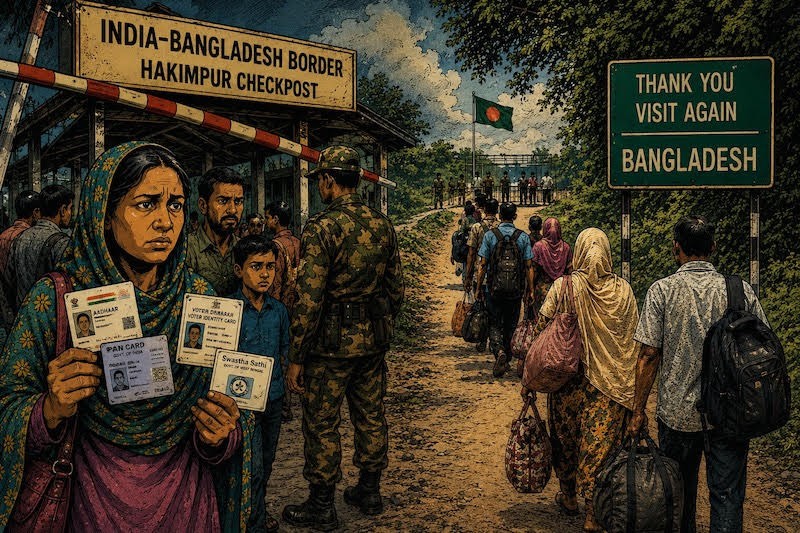
The woman answering was Bangladeshi. She stood at the Hakimpur checkpost in North 24 Parganas, bags in hand, ready to cross back. She had lived inside India for years, drawing on welfare schemes, holding Indian identity documents, casting Indian votes. Now, with the BJP in power in West Bengal and a sweeping crackdown underway, she was leaving.
A few metres away, a man made his own quiet admission to the cameras. "We came as poor people, for food and livelihood," he said. "Now we have to go back. You cannot blame Indians for this. We got all our documents made during the rule of Trinamool."
In those two exchanges lies the full arc of one of India's most politically charged, longest-denied, and now undeniable crises.
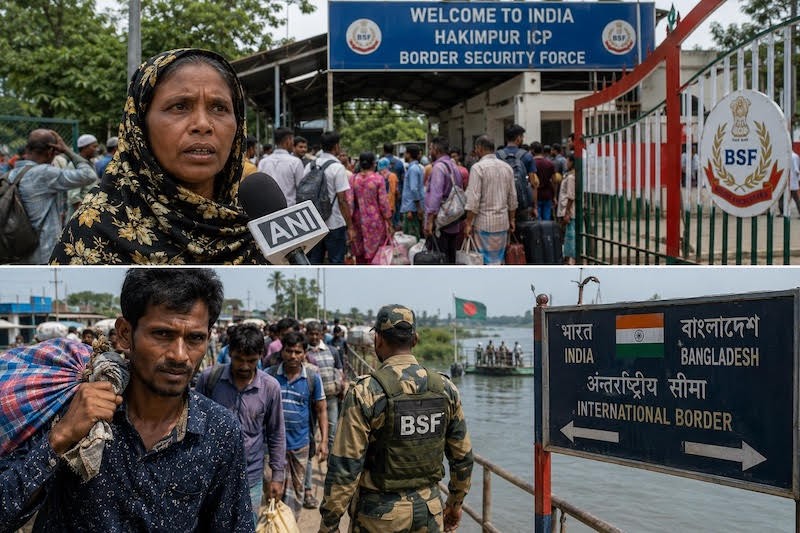 At the Hakimpur border, years of invisible migration end with a long walk back home. Photo: AI-generated
The scenes at the Hakimpur checkpost in Basirhat, North 24 Parganas, tell the story without embellishment. Families with bundled belongings. Men who worked as mechanics and labourers in West Bengal for years, quietly joining the queue to cross back.
Women clutching documents that were, until recently, their shield — Aadhaar cards, ration books, health cards issued under the Swastha Sathi scheme — now rendered worthless by the very crackdown those documents had long evaded.
The Porous Line
The India-Bangladesh border stretches 4,156 kilometres. Large sections of it — particularly through the flat, riverine terrain of West Bengal — have for decades been only partially fenced, poorly lit, and lightly patrolled. Rivers shift. Paths through paddy fields are unmarked. Villages straddle both sides of a line that Partition drew in 1947 and that geography has always quietly resisted.
Migration across this border is as old as the border itself. The great displacement of 1947 sent millions of Hindus westward into India. In 1971, as the Bangladesh Liberation War unleashed one of the worst humanitarian catastrophes of the 20th century, another wave arrived, fleeing Pakistani military violence. India absorbed them. The moral logic then was clear.
What followed — slowly, steadily, over decades — was different. Economic migration, not refugee flight. People crossing not in fear of soldiers but in search of work and a marginally better life. The obligingly porous border made it easy.
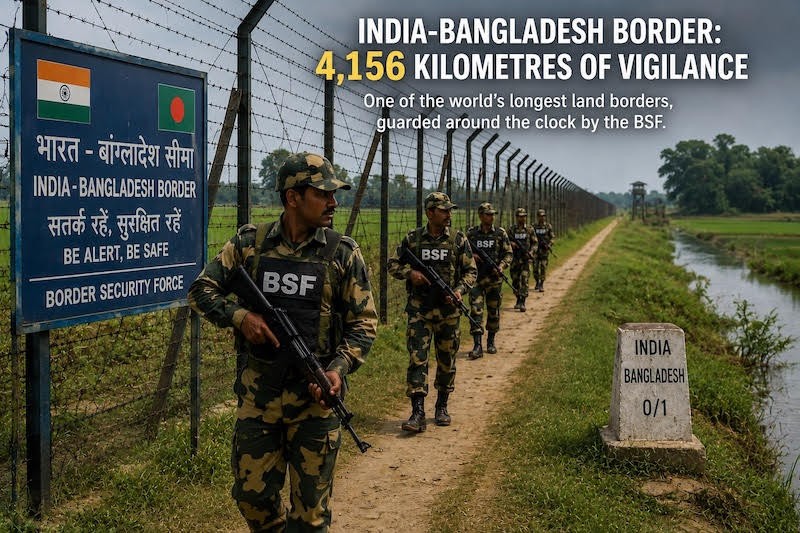 BSF guards one of the world's largest land borders. Photo: AI-generated
By the 1980s, the scale of illegal entry was significant enough to drive political violence in Assam, culminating in the Assam Accord of 1985. The National Register of Citizens that emerged from that accord took another 34 years to finalise — and when it was, in 2019, it excluded nearly two million people.
Bengal was a different story. Here, political calculations intervened where border fences did not.
The Document Economy
For years, India's border districts ran a quiet parallel economy — not in goods, but in identity. Agents helped new arrivals obtain ration cards. Ration cards unlocked Aadhaar enrolments. Aadhaar enabled PAN cards, voter ID registrations, and access to government welfare schemes. The chain backed by Bengal's ruling political parties hungry for Muslim votes was well-oiled and widely known.
Some illegal Bangladeshis lived in India for more than ten years, participated in the voting process, and enlisted their names in multiple government welfare schemes.
The BJP has long accused previous governments in West Bengal of allowing illegal infiltration for political and electoral reasons, with the issue remaining particularly sensitive in border districts like North 24 Parganas, Nadia, Murshidabad, Malda, and Cooch Behar.
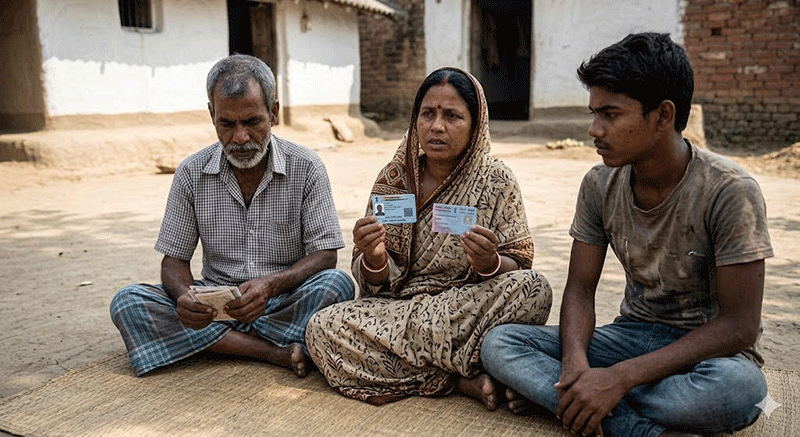 Some illegal Bangladeshis obtained every Indian government document. Photo: AI-generated
The political logic was brutally simple. Millions of undocumented voters in key constituencies were a reliable electoral bloc. Parties that looked the other way — or actively facilitated document-making — reaped the dividends at election time.
The Trinamool Congress, which governed Bengal from 2011, denied the scale consistently. Now, with the BJP forming the state government, what was denied for years is being documented on camera, at the border, in real time.
Detect. Delete. Deport.
The West Bengal government's current drive operates under a three-word doctrine. The Detect, Delete and Deport policy is pushing a growing number of illegal Bangladeshi immigrants towards the international border. At the Hakimpur checkpost, unusually large crowds have been seen, with many of those present reportedly accused of living unlawfully in India. Several people reaching the border said there was no work left and the administration was no longer allowing them to remain.
The West Bengal government has begun setting up dedicated holding centres to detain illegal Bangladeshi immigrants and Rohingyas before deportation. Malda became the first district to operationalise such a centre, currently housing nine suspected Bangladeshi nationals including three women and six minors.
An order issued on May 23 instructed authorities to take action against Bangladeshi nationals and Rohingyas whose repatriation process is still pending, with growing discussion that detainees may be directly handed to the BSF rather than held in centres through prolonged legal procedures.
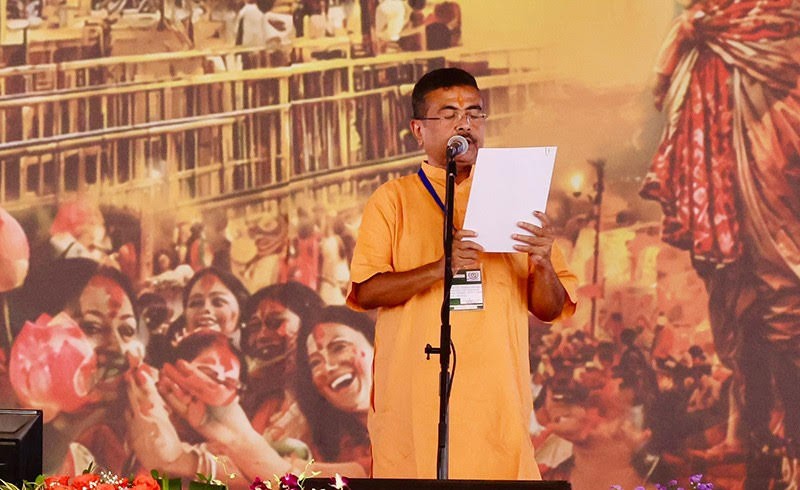 Gamechanger: Suvendu Adhikari takes oath as West Bengal’s first BJP Chief Minister. Photo: Avishek Mitra/IBNS
The crackdown has a national dimension. Approximately 700 undocumented migrants were repatriated from Delhi to Bangladesh in the six months following the Pahalgam terror attack, with Delhi ranking highest among all states in the number of individuals deported across the eastern land border. Rajasthan, Gujarat, Maharashtra, Uttar Pradesh and Goa have all conducted operations.
Mumbai opened its first dedicated detention centre in March 2026, resolving a prior situation where police had held over 1,000 alleged Bangladeshis in station rooms in 2025 alone.
The Bandra Moment
The Western Railway this month launched a five-day anti-encroachment drive near Bandra East railway station of Mumbai, following the Bombay High Court’s order allowing them to remove the illegal structures. Illegal immigrant Bangladeshis fled the area in large numbers.
However, Mumbai offered a prescient image of the scale of invisible migration long before the current crackdown.
In April 2020, during the Covid lockdown, between 4,000 and 5,000 people had gathered at Bandra railway station within hours after rumours spread of special trains home. Police dispersed them with force. What was less discussed at the time — and has come sharply into focus since — is how many among those crowds were not domestic migrants but undocumented illegal Bangladeshis, invisible to the system until a crisis made them uncomfortably visible.
The pattern persisted long after. In one case in 2026, a 41-year-old Bangladeshi woman was arrested in Dharavi having re-entered India after being deported in July 2025. She had travelled by train from Howrah to Dadar, assisted by an agent who helped her create documents.
One deportation was not always enough. Delhi Police separately busted a gang that created fake documents through a fraudulent website, enabling illegal Bangladeshis to sustain their stay. The infrastructure of false identity had become an industry.
The Demographic Alarm
For decades, the charge of demographic change in Bengal was treated as nationalist hyperbole. The numbers, slowly assembled, tell a more complicated story. Border districts — Murshidabad, Malda, North and South 24 Parganas — have seen consistent demographic shifts over successive censuses.
BJP leaders have repeatedly claimed that illegal immigration has altered the demographic balance of several regions, an issue that has remained politically sensitive across border districts for decades.
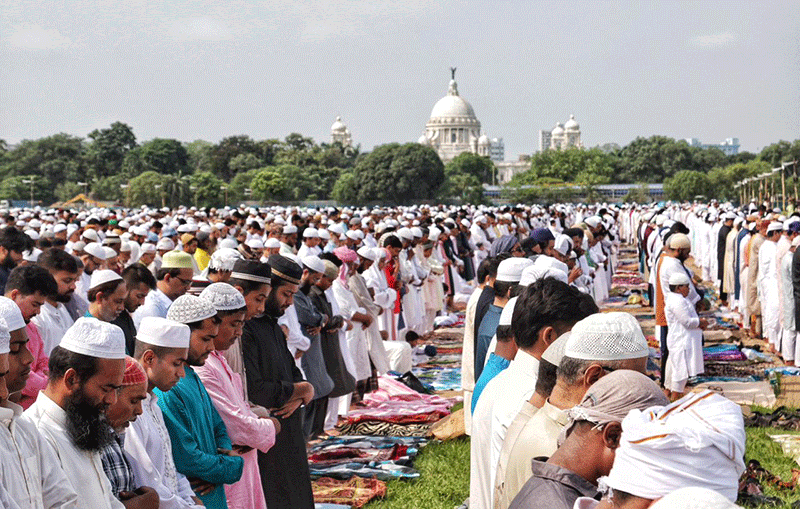 Thousands of Indian Muslims gathered at Kolkata’s iconic Brigade Parade Ground to offer Namaz. Photo: IBNS
The question of who is a genuine Indian Muslim Bengali and who is an undocumented illegal Bangladeshi remains the most fraught distinction in Indian politics.
The Calcutta High Court has already intervened, setting aside the deportation of two women and their families from Birbhum district after they were termed illegal immigrants, ordering their return within four weeks — a reminder that enforcement without due process risks catching genuine citizens in its sweep.
That tension — between a real, documented problem and the risk of its weaponisation against legitimate citizens — sits at the heart of this crisis.
The Road Back
Approximately 1,600 Bangladeshi nationals returned through the Hakimpur checkpost alone since the Special Intensive Revision began, with the BSF handing them over to the Border Guard Bangladesh after taking biometrics and completing documentation.
Bangladesh has objected to what it calls push-ins and increased its own border vigilance. The 60th Battalion of Border Guard Bangladesh deployed loudspeakers in border villages, warning residents to stay alert against illegal crossings. The deportation drive is straining a bilateral relationship that matters enormously — for trade, water-sharing, and regional stability.
They crossed into India through a border India failed to adequately fence. They obtained documents India's own system allowed them to acquire. They voted in elections that Indian political parties encouraged them to participate in. They drew from welfare schemes that Indian governments enrolled them in. Now they are being counted, identified, deleted, and deported.
"We came as poor people," the man at Hakimpur said. "We cannot blame Indians for this."
He is right on both counts. The poverty that drove them here was real. The failure — of border management, document integrity, and political will — was equally real, and it was entirely India's own making.
The fence, at last, is being built.