
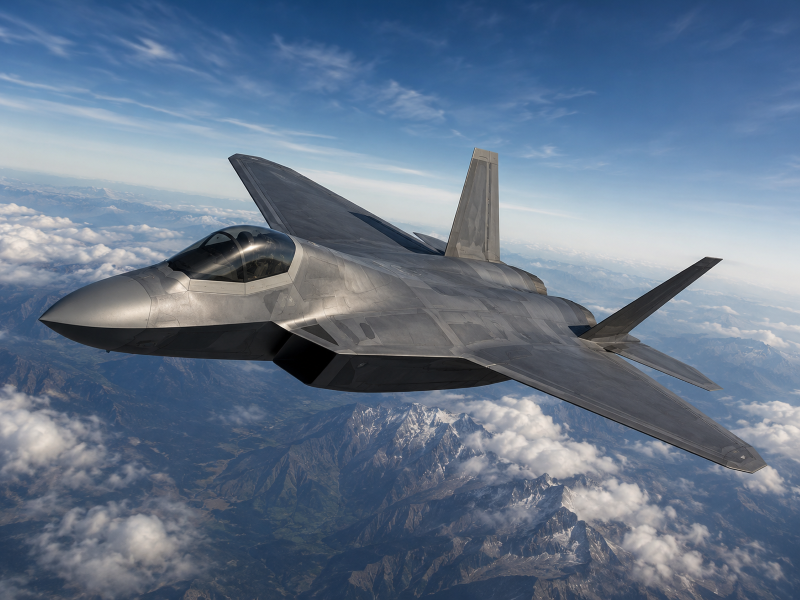
In a landmark decision, the Defence Ministry has kept state-run Hindustan Aeronautics Limited (HAL) out of the programme and instead shortlisted three private sector consortiums for the project.
The shortlisted contenders are:
- Tata Advanced Systems
- The L&T-BEL-Dynamatic consortium led by Larsen & Toubro
- The Bharat Forge-BEML-Data Patterns consortium led by Bharat Forge
The move marks the first time India has opened a major fighter jet development programme entirely to private players.
Rs 15,000 Crore Prototype Project
The government is fully funding the Rs 15,000 crore programme, which involves building five flying AMCA prototypes and one structural test aircraft.
The winning bidder will work alongside the Aeronautical Development Agency (ADA) under the Defence Research and Development Organisation (DRDO).
The aircraft will be developed at a new 650-acre greenfield aerospace facility planned in Puttaparthi.
Officials say the project is aimed at accelerating indigenous fighter aircraft production while reducing dependence on foreign defence platforms.
Timeline for India’s Stealth Fighter Programme
The ADA and DRDO had first issued an Expression of Interest for the AMCA programme in mid-2025, attracting bids from seven players.
Following technical evaluations earlier this year, three private groups were shortlisted.
The companies are expected to submit detailed bids within the next two to three months.
Officials expect:
- Final contract award between January and March 2027
- First prototype flight between 2028 and 2032
- Operational induction after 2035
Series production is expected to take place at the new Andhra Pradesh facility.
India joins elite Fifth-Generation Fighter race
Once operational, the AMCA would place India among a small group of nations capable of developing fifth-generation stealth fighters.
Currently, only the United States has the Lockheed Martin F-22 Raptor and Lockheed Martin F-35 Lightning II; China has the Chengdu J-20; and Russia has the Sukhoi Su-57.
Key features of AMCA
The AMCA is expected to be a twin-engine, single-seat stealth fighter equipped with:
- Advanced radar-evading stealth coatings
- Internal weapons bays
- Long-range strike capability
- High-end electronic warfare systems
According to officials, the aircraft could have:
- An operational ceiling of 55,000 feet
- 1,500 kg weapons capacity in internal bays
- Additional external payload capacity of 5,500 kg
- Fuel carrying capacity of around 6,500 kg
The project is being seen as a major milestone in India’s push for self-reliance in advanced aerospace and defence technology.