
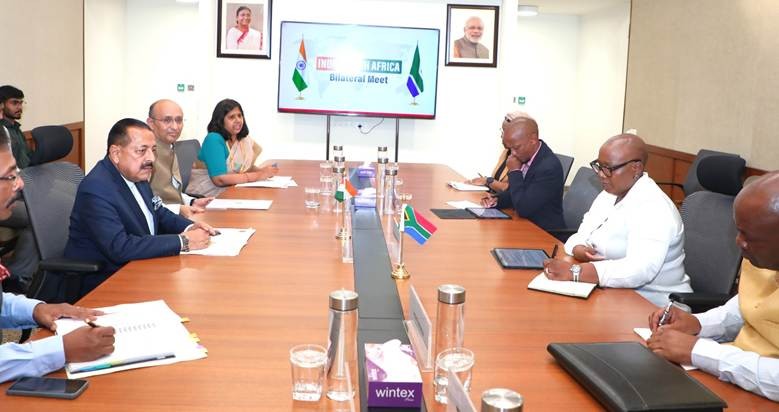
During talks with South Africa Deputy Minister of Science, Technology and Innovation Dr Nomalungelo Gina, who called on him accompanied by a high-level delegation, Union Minister Dr Jitendra Singh called for taking the relationship beyond traditional research cooperation towards innovation-driven partnerships capable of delivering economic and societal impact at scale.
Holding bilateral talks with Dr. Nomalungelo Gina, Deputy Minister of Science, Technology and Innovation of South Africa, Dr Jitendra Singh said that the next phase of India-South Africa engagement must be shaped by emerging technologies, innovation ecosystems, startup partnerships and industry-linked research. He said the two countries possess complementary strengths that can be leveraged to create affordable, scalable and inclusive technological solutions for the developing world.
The Minister said India and South Africa share a unique partnership forged through a common history, democratic values and a shared commitment to inclusive growth.
He noted that as influential voices of the Global South, both countries are increasingly contributing to shaping international conversations on science, technology and innovation through platforms such as BRICS, IBSA, G20 and IORA, while also advancing bilateral cooperation across multiple strategic sectors.
The meeting was held at the Kartavya Bhawan in New Delhi. The Indian delegation included Dr. Rajesh S. Gokhale, Secretary, DST, senior officials of the Department and representatives from the Ministry of External Affairs. The South African delegation was led by Deputy Minister Dr. Nomalungelo Gina and comprised senior officials from the Department of Science, Technology and Innovation and the South African High Commission.
Dr. Jitendra Singh said India has emerged as one of the world’s fastest-growing innovation ecosystems, supported by major national initiatives in Artificial Intelligence, Quantum Technologies, Cyber-Physical Systems, Digital Public Infrastructure and startup-led innovation. He said these advancements present new opportunities for collaborative research, technology development and innovation partnerships with South Africa.
Emphasising that science must increasingly translate into solutions that improve lives, generate employment and strengthen economies, the Minister called for deeper engagement among research institutions, innovation agencies, startups and industry from both countries.
He said future cooperation should focus not only on scientific excellence but also on technology deployment, commercialization and societal outcomes.
A key outcome of the discussions was the decision to intensify collaboration in Advanced Materials and Manufacturing, Geospatial Technologies and Digital Infrastructure, priority areas identified under the India-South Africa Joint Committee mechanism. Both sides agreed to accelerate interactions among scientists, institutions and technical experts to transform these focus areas into concrete collaborative programmes and outcomes.
The discussions also highlighted substantial opportunities in biotechnology, genomics, vaccine development, health technologies and pandemic preparedness. Dr. Jitendra Singh said recent global experiences have reinforced the importance of resilient healthcare systems and scientific partnerships, adding that India’s strengths in biotechnology, affordable healthcare innovation and vaccine manufacturing offer significant scope for collaboration with South Africa.
South Africa expressed strong interest in expanding cooperation with India in renewable energy, hydrogen technologies, advanced manufacturing, digital technologies, health sciences, vaccine research and skills development. Dr. Gina said South Africa values India as a trusted partner and is keen to strengthen institutional linkages, research collaboration and innovation partnerships across priority sectors.
Recalling the strong foundation of bilateral scientific engagement, she noted that the two countries have already built an extensive network of collaborative research initiatives, including nearly 150 co-funded projects across diverse scientific disciplines. She expressed confidence that the partnership is now well-positioned for significant expansion in emerging technology domains and innovation-driven collaboration.
The two leaders also reviewed cooperation in astronomy, one of the flagship areas of India-South Africa scientific engagement. Dr. Jitendra Singh highlighted the significance of the Square Kilometre Array (SKA) project, describing it as one of the most ambitious scientific endeavours of the century and a powerful example of how international collaboration can drive scientific discovery, advanced computing capabilities, technological innovation and human resource development.
Recognising the growing importance of multilateral scientific engagement, Dr. Jitendra Singh invited South Africa’s active participation in the BRICS Science, Technology and Innovation Ministerial Meeting scheduled to be held in Chennai in August 2026. He said BRICS cooperation is creating new opportunities for collaborative research in areas such as high-performance computing, artificial intelligence, renewable energy, biotechnology, water resources, precision agriculture and materials science.
The South African side also invited India to participate in the Science Forum South Africa 2026, one of Africa’s premier platforms for global scientific dialogue, knowledge exchange and innovation partnerships. Both sides welcomed the opportunity to further strengthen scientific engagement through regular institutional interactions and high-level exchanges.
India and South Africa have maintained a vibrant Science and Technology partnership since the signing of the bilateral S&T Agreement in 1995. Over the years, the relationship has expanded across astronomy, biotechnology, health sciences, indigenous knowledge systems, renewable energy, advanced materials and earth sciences. The two countries have jointly supported dozens of research projects and continue to deepen collaboration through structured institutional mechanisms.
The meeting concluded with a shared resolve to build a stronger, future-ready innovation partnership driven by research excellence, technology development, startup collaboration and people-to-people scientific exchanges, with the objective of generating meaningful benefits for both nations and contributing to the broader development aspirations of the Global South.