
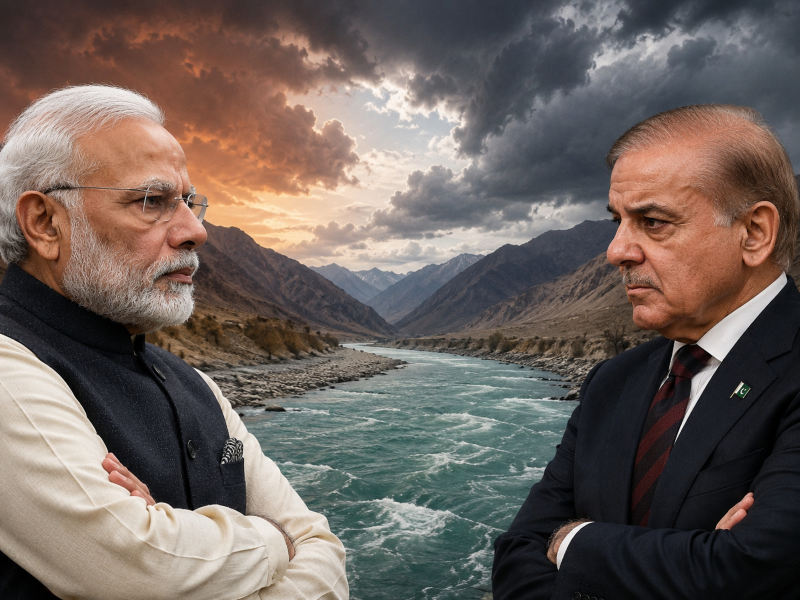
Responding to Pakistan's recent statements on the treaty, Ministry of External Affairs (MEA) spokesperson Randhir Jaiswal said India's position has remained unchanged since the suspension was announced following the April 2025 terror attack in Jammu and Kashmir's Pahalgam, which claimed the lives of 26 tourists.
"India's position on the Indus Waters Treaty is consistent. IWT stands in abeyance in response to Pakistan's continued sponsorship of cross-border terrorism. Pakistan must credibly and irrevocably abjure its support for cross-border terrorism," Jaiswal said during the weekly media briefing.
India stands firm
India placed the treaty in abeyance after the deadly Pahalgam terror attack, arguing that continued cross-border terrorism undermines the basis for normal bilateral cooperation.
New Delhi has repeatedly maintained that the suspension is directly linked to Pakistan's alleged support for terrorist groups operating across the border and that the treaty cannot be restored unless Islamabad takes verifiable and irreversible steps to dismantle the terror infrastructure.
Pakistan's diplomatic push
Pakistan has intensified its diplomatic outreach in recent weeks, arguing before the international community that India's decision sets a dangerous precedent for countries sharing transboundary rivers.
Earlier this week, Pakistan's Deputy Prime Minister Ishaq Dar insisted that Islamabad does not recognise India's move and maintained that the treaty "remains valid, binding and operative."
Adding to the rhetoric, former Pakistani foreign minister Bilawal Bhutto Zardari stirred controversy by suggesting Pakistan should consider a "nuclear option" if efforts to restore the treaty fail.
His remarks have drawn criticism from strategic observers, who described them as provocative and irresponsible.
India's legal position
India has consistently argued that while the treaty remains in abeyance, it is no longer obligated to fulfil its commitments under the agreement.
In June 2025, the MEA asserted that no arbitration mechanism, including what it described as an "illegally constituted arbitral body," has jurisdiction to examine India's sovereign decision regarding the treaty.
The Indus Waters Treaty, brokered by the World Bank and signed in 1960 after nearly a decade of negotiations, governs the sharing of the Indus river system and its tributaries between India and Pakistan.
Despite multiple wars and prolonged diplomatic tensions, the agreement had remained operational for more than six decades before India suspended its implementation.
International support against terror
India also pointed to growing international recognition of concerns over cross-border terrorism.
A day earlier, India and Japan issued a joint statement strongly condemning cross-border terrorism originating from Pakistan and called for decisive global action against terror safe havens and financing networks following bilateral talks between Prime Minister Narendra Modi and his Japanese counterpart.
India condemns Pakistan's strikes in Afghanistan
During the same media briefing, Jaiswal also reiterated India's condemnation of Pakistan's military strikes inside Afghanistan, which reportedly resulted in significant civilian casualties.
"We had strongly condemned the airstrikes that happened from Pakistan into Afghanistan, in which several civilian lives, including women and children, were lost. We had offered our condolences... and reiterated our strong support for the territorial integrity and sovereignty of Afghanistan," he said.
India has maintained that its humanitarian engagement with Afghanistan remains guided by its commitment to the Afghan people while continuing to support the country's sovereignty and territorial integrity.