
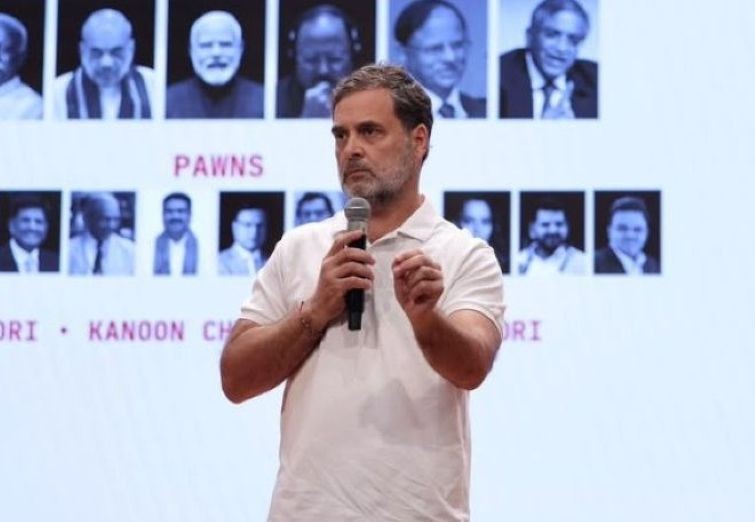
Addressing a press conference in New Delhi, Gandhi accused the Election Commission of ignoring objections raised by two Election Commissioners over issues including the Special Intensive Revision (SIR) of electoral rolls.
He demanded Kumar's resignation and said the Congress would not remain silent if, in its view, democratic institutions were being undermined.
मैं तीन साल से वोट चोरी का पर्दाफ़ाश करता आ रहा हूँ। अब चुनाव आयुक्त खुद इसे स्वीकार कर सच्चाई उजागर कर रहे हैं।
— Rahul Gandhi (@RahulGandhi) September 24, 2026
ज्ञानेश कुमार ने देशद्रोह किया है। वो अभी इस्तीफ़ा दें और approver बन जाएं।
वोट चोरी की साज़िश में नरेंद्र मोदी और अमित शाह की पूरी जांच होगी। pic.twitter.com/l7K0e1fSua
Gandhi argued that the vote was the foundation of India's constitutional system. He said that if votes were compromised, the legitimacy of the Constitution, Parliament and laws made by elected representatives would also come under question.
‘Vote chori’ becomes ‘kanoon chori’
Gandhi linked his allegations of "vote chori" to what he described as a wider chain of consequences — "kanoon chori" and "sanstha chori", or the alleged theft of laws and institutions.
He claimed that MPs were occupying their seats based on "stolen votes" and therefore questioned the legitimacy of laws passed by Parliament.
The Congress leader also alleged that the 2024 Lok Sabha election and subsequent Assembly elections had been "rigged".
These remain allegations made by Gandhi and the Congress; the Election Commission has defended its electoral-roll processes and said decisions relating to the SIR were unanimous.
Rahul Gandhi questions ‘disappearance’ of anti-incumbency
Gandhi also questioned why the BJP, Prime Minister Narendra Modi and Union Home Minister Amit Shah appeared to have escaped the anti-incumbency trend that has historically affected governments across India.
The vote is the foundation of Indian democracy.
— Rahul Gandhi (@RahulGandhi) September 24, 2026
From the vote flows the power of our Constitution, the authority of our laws, and the legitimacy of our public institutions - this chain defines modern India.
Today this chain is broken, and this has never happened in India… pic.twitter.com/rUnA4uU8B7
Citing examples including Haryana, Maharashtra and Uttar Pradesh, he said voters had repeatedly switched between political parties in these states, while claiming that the same pattern had seemingly disappeared in recent elections.
He referred to former Prime Minister Indira Gandhi's experience after the 1971 Bangladesh war, arguing that even leaders at the height of their popularity eventually faced anti-incumbency.
According to Gandhi, this led the Congress to question why the usual electoral cycle appeared different in the case of the BJP-led government.
‘Gyanesh Kumar should resign’
Gandhi said two Election Commissioners had raised questions about decisions taken by the poll body and alleged that their objections had been ignored.
"Two Election Commissioners have raised questions against Gyanesh Kumar. I have done the same. And those questions were ignored," he said.
He demanded that Kumar resign and accused him of acting against the interests of the country. Gandhi also urged the CEC to "turn approver", arguing that doing so would amount to an act of nationalism.
BJP rejects allegations
The BJP dismissed Gandhi's press conference and accused him of making allegations after failing to secure public support through democratic means.
BJP spokesperson Pradeep Bhandari hit back at the Congress leader, saying the "Gandhi-Vadra family" had been placed in the Opposition by voters through democratic elections.
CONGRESS HISTORY EXPOSES RAHUL GANDHI -
— Pradeep Bhandari(प्रदीप भंडारी)🇮🇳 (@pradip103) September 24, 2026
Rahul Gandhi says, “Anti-incumbency does not exist.”
But history tells a more nuanced story.
From 1952–1962, Congress won every Lok Sabha election and remained in power at the Centre.
In Rae Bareli, Congress has won 16 times when the… pic.twitter.com/zaY9Tm5MIE
The Election Commission, meanwhile, has maintained that internal objections are part of its functioning and has said that decisions on the SIR were taken unanimously.