
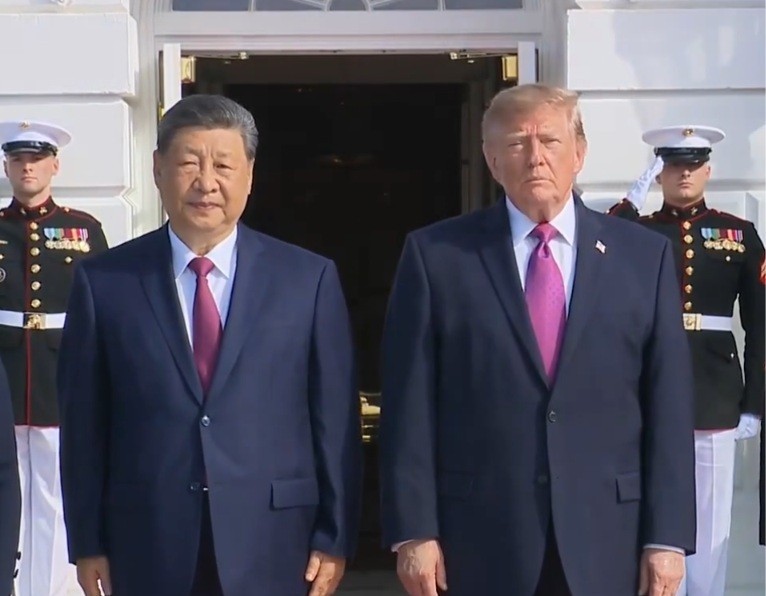
Xi said Washington and Beijing have both the “capability and responsibility” to develop and manage AI responsibly.
However, he did not outline specific rules, safeguards or mechanisms that the two countries should adopt.
#WATCH | Washington, DC: At the White House, Chinese President Xi Jinping says, "China and the United States are different in national conditions, but through candid, in-depth, and continued dialogue, our two countries can understand each other better, seek common ground while… pic.twitter.com/6WBtsklR4j
— ANI (@ANI) September 24, 2026
Trump, Xi stop short of AI agreement
Despite placing AI high on their bilateral agenda, Trump and Xi did not announce a formal agreement or a joint framework for governing the technology during their opening remarks.
"President Xi and I have forged a friendship, a truly great friendship actually, built on the mutual respect and the vital interests of our people."
— The White House (@WhiteHouse) September 24, 2026
President Trump welcomes President Xi Jinping, Madame Peng Liyuan, and the Chinese delegation to the White House to begin their… pic.twitter.com/48bcpMGRGC
The discussions come as both countries compete for dominance in advanced AI while facing growing concerns over safety and control.
Ahead of the meeting, Trump had indicated on Truth Social that he wanted to leave AI development largely as it stands, saying the US “guardrail” was the Department of Justice.
Earlier, Trump extended a warm welcome to Xi Jinping at the White House.
"President Xi and I have forged a friendship, a truly great friendship actually, built on the mutual respect and the vital interests of our people."
— The White House (@WhiteHouse) September 24, 2026
President Trump welcomes President Xi Jinping, Madame Peng Liyuan, and the Chinese delegation to the White House to begin their… pic.twitter.com/48bcpMGRGC
US proposes AI incident notification mechanism
The talks follow discussions between US Treasury Secretary Scott Bessent and Chinese Vice Premier He Lifeng earlier this week.
Washington proposed a “notification mechanism” under which the two countries could alert each other about AI incidents that could pose national security risks.
Bessent said the aim was to create greater transparency between the world's two leading AI powers and develop a shared understanding of common risks.
AI rivalry overshadows White House summit
AI has emerged as one of the most sensitive issues in the broader US-China relationship, alongside trade and strategic technology.
Both governments have sought to maintain their technological edge while grappling with questions over the risks posed by increasingly capable AI systems.
Xi's state visit, his first to Washington in more than a decade, comes amid wider efforts by the two sides to manage tensions over trade, technology and other strategic issues.
President Donald J. Trump and First Lady Melania Trump greet Xi Jinping, President of The People’s Republic of China, and Madame Peng Liyuan to the White House for their official state visit. pic.twitter.com/4Nw0NP96Zx
— The White House (@WhiteHouse) September 24, 2026