
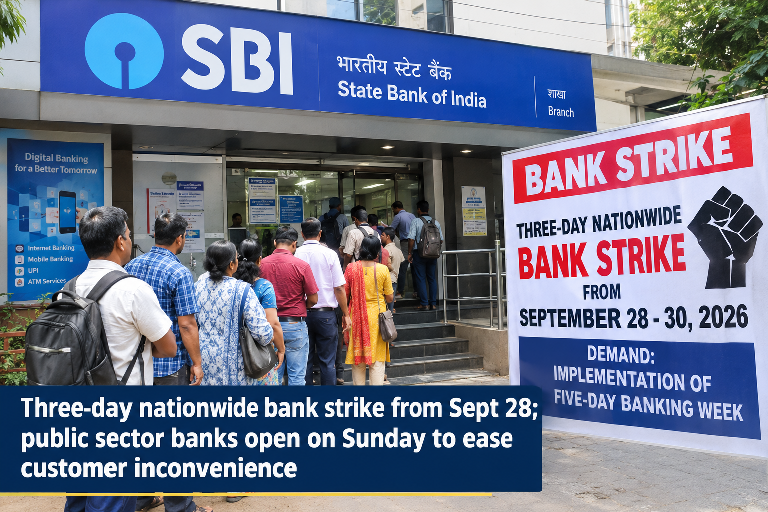
Public sector banks (PSBs) and Regional Rural Banks (RRBs), including those in Tripura, remained open on Sunday to help customers complete essential banking transactions ahead of a three-day nationwide bank strike beginning on Monday, September 28.
The strike, scheduled from September 28 to 30, has been called by the United Forum of Bank Unions (UFBU) to press for the immediate implementation of a five-day banking week, along with other long-pending demands. All branches of public sector banks and regional rural banks across Tripura are expected to remain closed during the three-day agitation.
The special Sunday banking arrangement was introduced following a meeting held on September 21 involving officials from the Ministry of Finance, the Indian Banks' Association (IBA), NABARD, public sector banks and regional rural banks. The decision was taken to minimize inconvenience to customers, as the strike follows the weekend and could otherwise have disrupted branch banking services for several consecutive days.
Among the public sector banks that remained open on Sunday were the State Bank of India (SBI), Punjab National Bank (PNB), Bank of Baroda (BoB), Canara Bank, Bank of India, Indian Bank, Union Bank of India, Central Bank of India, UCO Bank, Bank of Maharashtra, Indian Overseas Bank and Punjab & Sind Bank. The arrangement also covered 28 Regional Rural Banks across the country, including Tripura Gramin Bank. However, the special opening did not automatically apply to private sector banks.
The UFBU said the nationwide strike has been necessitated by the prolonged delay in implementing a five-day banking week despite an agreement signed between the IBA and the unions on March 30, 2024. Under the proposed arrangement, banks would function for five days a week, while employees would work an additional 40 minutes each day to maintain customer service.
According to the UFBU, nearly 30 months have passed since the agreement was signed, but approval from the Union Ministry of Finance is still pending. The union said repeated discussions with the IBA and the Department of Financial Services (DFS), as well as earlier protest programmes, have failed to produce any concrete outcome.
The banking unions recalled that a proposed two-day strike in March this year was withdrawn after assurances from the authorities that the issue was under active consideration. However, with no progress since then, the unions observed a nationwide one-day strike on September 11 and have now intensified their agitation with a three-day strike.
UFBU leaders argued that banking operations have expanded significantly over the years, with banks now handling insurance, mutual funds and several other financial services in addition to conventional banking. At the same time, staff shortages have increased the workload on employees, many of whom continue working well beyond official business hours.
The unions maintained that the introduction of a five-day banking week would improve work-life balance, enhance productivity and bring the banking sector in line with the Reserve Bank of India, financial markets and most Central and State government offices, which already observe two-day weekends.
In a statement, UFBU Tripura Convenor Sanjoy Datta said bank employees and officers were prepared to sacrifice three days' wages to press for their demands. Along with the earlier one-day strike this month, participants would forgo four days' salary in September.
Apart from implementing a five-day banking week, the UFBU has also demanded an end to what it described as discriminatory Performance Linked Incentive (PLI) schemes and called for adequate recruitment to address staff shortages and the growing workload in the banking sector.
The union has warned that if the demands remain unresolved, it will launch an indefinite nationwide strike from October 26, 2026.