
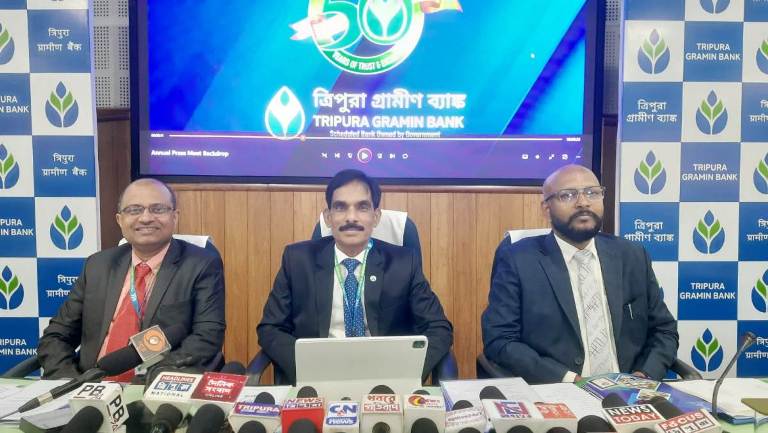
Tripura Gramin Bank (TGB), one of the leading financial institutions among India’s 28 Regional Rural Banks (RRBs), has reported a net profit of Rs 184.84 crore for the financial year 2025–26, marking its 14th consecutive year of profitability.
Addressing the annual press of briefing of Tripura Gramin Bank at Pragna Bhavan in Agartala on Saturday , Chairman Satyendra Singh along with General Manager Anup Kumar Saha, and Chief Manager Sailesh V Ranjan shared key insights into the bank’s financial performance, customer service initiatives, expansion of digital banking, and future roadmap.
TGB chairman said that in terms of business growth, performance and overall achievements, the bank has secured the second position among the 28 RRBs in the country, next only to Telangana Grameena Bank.
“As of March 2026, the bank registered a net profit of Rs 184.84 crore. The bank has been consistently profitable since 2011–12,” Singh said, adding that the institution continues to meet the financial targets set by the Government of India.
For the financial year 2025–26, the bank reported significant achievements, including total business of Rs 15,422 crore, deposits of Rs 10,889 crore, loan disbursement of Rs 4,532 crore, a CD ratio of 41.62%, and a net profit of Rs 184.84 crore. The bank also maintained a Gross NPA of 2.89% and achieved zero Net NPA.
With the largest branch network in the state, Tripura Gramin Bank has consistently played a leading role in advancing financial inclusion, supporting agriculture and rural development, empowering self-help groups, extending credit to small businesses, and delivering modern digital banking services, said Singh
The bank’s current Capital to Risk-Weighted Assets Ratio (CRAR) stands at an impressive 28.58 per cent — the highest among all 28 RRBs in the country — reflecting strong financial stability.
Established in 1976 with just four branches, Tripura Gramin Bank was founded with the mission of serving rural farmers, artisans and weaker sections of society.
“Today, we have evolved into a robust institution with 150 branches, 12 ultra small branches, and a presence across all eight districts of Tripura,” Singh said.
Highlighting the bank’s growth trajectory, he noted that from a modest business of Rs 4.52 lakh in 1976, TGB has achieved a total business of over Rs 15,422 crore in the 2025–26 financial year, underscoring its steady expansion and commitment to financial inclusion.
The bank’s total business grew by 9.49 per cent to Rs 15,422 crore during the financial year, while deposits rose to Rs 10,889 crore, indicating strong customer trust.
According to Singh, advances increased by 12.77 per cent to Rs 4,532 crore, and the Credit-Deposit Ratio improved to 41.62 per cent, demonstrating more effective credit deployment.
Out of the bank’s 27 lakh accounts, TGB continues to lead financial inclusion efforts in Tripura.
The bank has opened over 5.39 lakh Pradhan Mantri Jan Dhan accounts, enrolled 4.58 lakh customers under the Pradhan Mantri Suraksha Bima Yojana, 1.73 lakh under the Pradhan Mantri Jeevan Jyoti Bima Yojana, and 1.89 lakh under the Atal Pension Yojana, reflecting strong participation in key social security schemes.
The bank has also emerged as a frontrunner in implementing the Prime Minister’s flagship welfare programmes, ensuring transparent, swift and dignified delivery of benefits at the grassroots level.
Singh further said that during the last financial year, per-branch business reached Rs 102.81 crore, while per-employee business rose to Rs 17.77 crore, highlighting improved operational efficiency.
He emphasized that the bank’s extensive work under schemes such as the Kisan Credit Card, Pradhan Mantri Fasal Bima Yojana, Pradhan Mantri Jeevan Jyoti Bima Yojana, Pradhan Mantri Suraksha Bima Yojana, and the Atal Pension Yojana has significantly enhanced social and financial security for farmers, workers and other vulnerable sections of society.
Tripura Gramin Bank reaffirmed its commitment to continue working towards the overall development of the state, enhancing customer service, and strengthening inclusive banking in the future.