
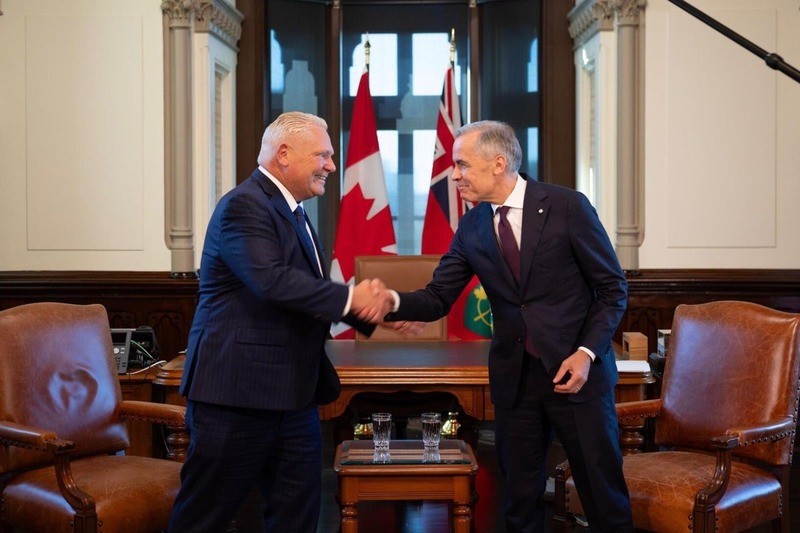
Prime Minister Mark Carney and Ontario Premier Doug Ford launched the plan in Ottawa, saying it would support the province's mining, steel and auto sectors as trade with the United States remains under strain.
Carney said Washington had "upended a trade bargain that has existed for decades," leaving Ontario workers and businesses at a disadvantage and under a cloud of uncertainty.
Where the money goes
The plan puts more than $5 billion into steel, $2.5 billion into auto and $1 billion into roads for the Ring of Fire.
The steel money will go to a new Joint Steel Action Fund, which the government says will help mills in Hamilton and Sault Ste. Marie upgrade machinery and make more products Canada needs.
The $2.5 billion for autos is meant to help plants shift toward connected and electric vehicles, with the government saying it will protect more than 120,000 direct jobs.
Ottawa will match Ontario's $1 billion to build road infrastructure to the Ring of Fire, a mineral-rich area more than 500 kilometres north of Thunder Bay.
The government says the region could add more than $22 billion to the economy and create an opportunity for 70,000 jobs.
Faster approvals
Carney said it has historically taken more than 15 years to open a mine in Ontario, and the two governments will set up a coordinated federal-provincial permitting process to cut duplication and wait times.
Bill C-39, the Building Canada Strong Act, is meant to deliver "one project, one review, one year," the prime minister said.
The two governments will also create a working group with local Indigenous communities to identify opportunities for economic development, conservation and Indigenous protected areas.
Steel and autos
Carney said Canada imports more than 6.5 million tonnes of steel a year, often because domestic mills do not make what Canadian companies need, and called it "time to be our own best customer."
A joint steel working group will recommend ways to lower the cost of moving Canadian steel and to open new markets, and Border Services enforcement against foreign steel dumping will be strengthened.
Carney said Canada's auto exports to the United States have fallen by more than 10%, while U.S. exports to Canada have dropped by over 20%.
Canada remains ready to negotiate a fair deal when Washington is ready to talk in good faith, he said, but accepted that this is not the aim of the current U.S. administration.
To ease the pressure on carmakers, federal fleet performance standards will be held at current levels from 2027 through 2029, according to the government, and a new Canada-Ontario automobile working group will carry out the measures.
The announcement builds on more than $30 billion the federal government says it is already investing in the steel, aluminum, lumber and auto sectors, which it says protects nearly 35,000 jobs.
Carney also pointed to the Productivity Mega Deduction, which lets businesses immediately deduct 100% of the cost of most new capital investment.
He said Canada's exports to non-U.S. markets are on track to double over the next 10 years.