
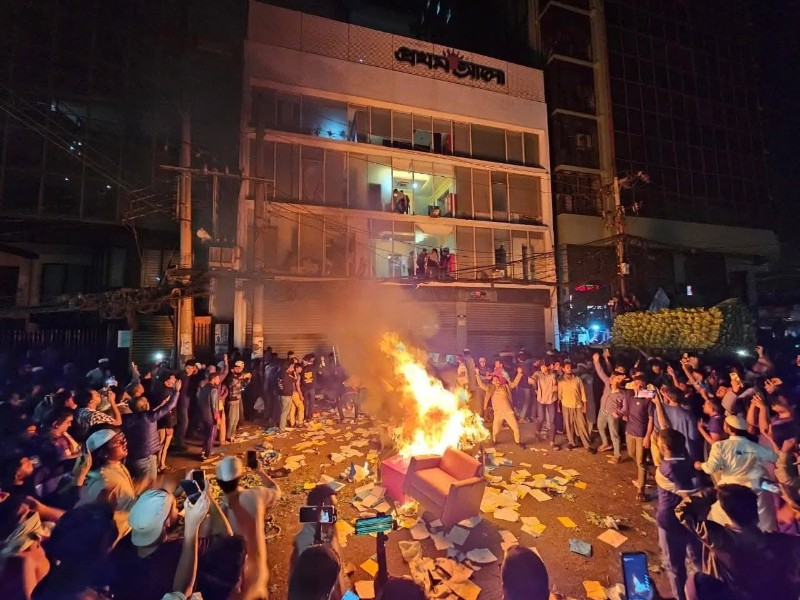
Hundreds of protesters, angered by the killing of radical activist Sharif Osman Hadi, ransacked the newspaper’s office and set parts of the premises ablaze.
Nearby, the office of The Daily Star was also attacked, leaving journalists trapped for hours as smoke filled the building.
Scary visuals of Daily Star Newspaper building in Dhaka when it was set afire. Over 30 journalists were stranded in the building. All rescued now by Bangladesh Army. pic.twitter.com/fLxRIliEbX
— Aditya Raj Kaul (@AdityaRajKaul) December 18, 2025
Panic unfolded late on Thursday night as staff members scrambled to escape.
Some journalists barricaded themselves on terraces to avoid the flames and vandalism below.
Over 30+ stranded Journalists and staff of Daily Star newspaper rescued by Bangladesh Army and Fire Brigade using a Sky ladder in Dhaka. All of them had taken shelter at roof top after Radical mobsters set the building afire after launching a major attack. Major tragedy averted. pic.twitter.com/hW0hjZq2Yn
— Aditya Raj Kaul (@AdityaRajKaul) December 18, 2025
Security forces, including army and police personnel, rescued those trapped only in the early hours of Friday, nearly four hours after the attacks began.
Arson spreads beyond Dhaka
The violence was not confined to the capital.
Prothom Alo offices in Kushtia, Khulna and Sylhet were also targeted, while attempts were reported to attack its bureaus in Chittagong and Bogra.
At The Daily Star’s nine-storey building near Farm Gate, parts of the structure were gutted by fire, forcing the paper to temporarily disrupt its publications.
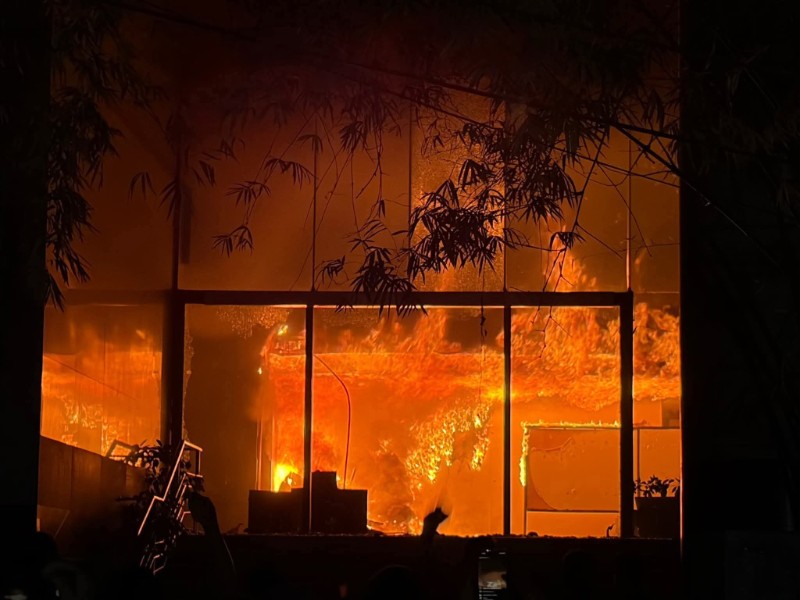 The Dhaka headquarters of Bangladesh's leading English daily, The Daily Star, was ransacked following Hadi's death. Photo: Social media
Disturbing images and messages circulated on social media during the chaos.
One journalist described suffocating conditions as smoke engulfed the newsroom, highlighting the life-threatening nature of the attacks.
"I can't breathe anymore," Zyma Islam, a reporter of Daily Star, posted on Facebook.
"There's too much smoke. I'm inside. You are killing me," she added.
Why were the newspapers targeted?
The mobs accused Prothom Alo and The Daily Star of creating an environment that led to Hadi’s assassination, allegations both newspapers strongly rejected.
Protesters hurled slogans branding the outlets as “pro-India” and sympathetic to ousted prime minister Sheikh Hasina, claims the papers have consistently denied.
Chants outside the offices framed the violence as part of a broader ideological battle, with demonstrators portraying independent journalism as an enemy of their political movement.
Observers say the attacks were less about the killing itself and more about settling scores with media houses known for critical reporting.
Role of misinformation and online incitement
Analysts have pointed to the role of online influencers in amplifying anger.
David Bergman, a London-based commentator on Bangladesh, said foreign-based Bangladeshi YouTubers played a key role in inciting mobs, shifting their targets from the former Awami League government to secular and independent media outlets.
In the days following Hadi’s death, unverified claims circulated widely, alleging that his killers were linked to Sheikh Hasina and had fled to India.
Police later said there was no credible evidence to support claims that the suspected shooter crossed into Indian territory, but the narrative had already taken hold on social media.
Political tensions ahead of elections
Bangladesh is heading into parliamentary elections scheduled for February 2026, and political violence has intensified in recent months.
Hadi’s killing has been seized upon by various factions to stoke anti-India sentiment and deepen polarisation.
Both Prothom Alo and The Daily Star suggested that vested interests exploited public grief and outrage to orchestrate coordinated attacks.
The Daily Star, in particular, criticised delays in the response by security forces, arguing that threats against the media were not taken seriously enough by the interim administration led by Muhammad Yunus.
A warning sign for press freedom
International media have struggled to pinpoint a single motive behind the attacks.
The BBC noted that while both newspapers were often criticised under Hasina’s rule, their continued scrutiny of the interim government may have angered its supporters.
Sharif Osman Hadi, a prominent figure of the July uprising and spokesperson of the radical Inqilab Mancha, was known for his fierce anti-India rhetoric and criticism of the Awami League.
Shot during his election campaign earlier this month, his death has now become a catalyst for unrest that extends far beyond his political legacy.
The torching of Dhaka’s leading newsrooms marks a troubling escalation, signalling how quickly political violence can turn against institutions that challenge dominant narratives.
According to experts, for Bangladesh’s media, the aftermath of Hadi’s killing has underscored a stark reality: in a climate of radicalisation and misinformation, independent journalism itself has become a target.