
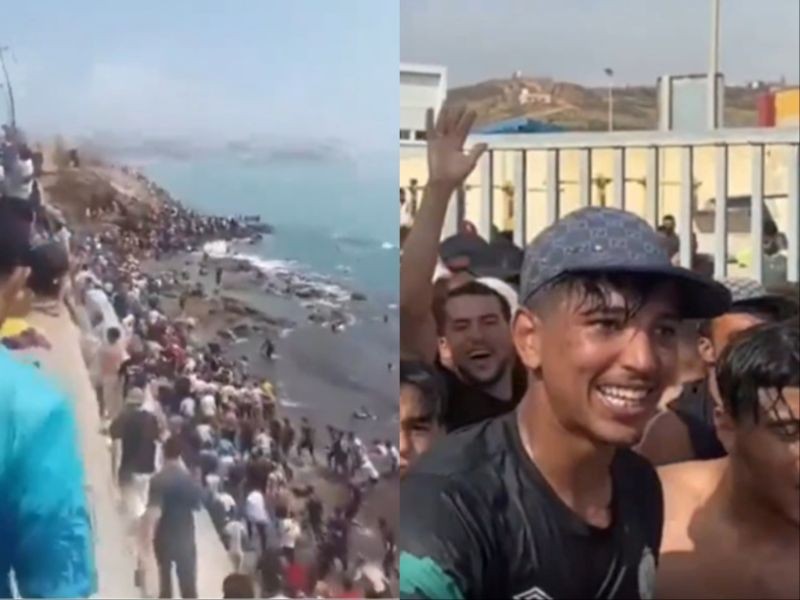
Adults and children, many of them still wet, were seen entering the town, while discarded flotation rings and clothes were found along the shore near where the frontier barrier meets the sea.
Ceuta President Juan Vivas said on Wednesday that around 1,500 migrants had arrived in the territory by sea over the past few days, describing the situation as a "total humanitarian and social emergency".
JUST IN: 🇪🇸 Law enforcement seen opening gates allowing thousands of illegal immigrants into Spain. pic.twitter.com/UUvMoRfqnY
— BRICS News (@BRICSinfo) July 30, 2026
Reception centres 'saturated'
Vivas said more than 200 people were entering Ceuta each day and that local reception centres had run out of space.
"The reception centres are saturated -- there is no more room for anyone in them," he said in comments broadcast by Spanish television.
Officials were not immediately available on Thursday to provide updated figures.
Police and Civil Guards appeared to make little attempt to stop the arrivals, although some officers directed migrants towards reception facilities.
Some migrants were seen celebrating as they walked through Ceuta, thanking Spanish police and shouting, "Bye bye, Morocco, hello Spain."
Hundreds gather on Moroccan side
On the Moroccan side of the border, hundreds of people, including children, were seen gathered near the frontier and the Moroccan town of Fnideq.
🔴 HORRENDOUS SCENES.
— Kosher (@koshercockney) July 30, 2026
Cueta Port in Spain has been overrun! Thousands of illegal migrants from Morocco and Algeria broken through the border forces.
How is this not invasion?
More footage in the thread pic.twitter.com/7jF5dAu1rN
Some told AFP they had travelled there after hearing rumours that the border would be opened on Thursday morning.
Moroccan authorities have not commented on the sudden influx.
The crossings coincided with Morocco's Throne Day, a major national celebration.
Spain promises 'immediate response'
Spanish Prime Minister Pedro Sanchez said his government was focused on providing an "immediate response" to the situation.
"We are mobilising all necessary resources, working with Moroccan and international authorities, and preparing the necessary measures to restore normality as soon as possible," Sanchez said on X.
El Gobierno de España está volcado en dar una respuesta inmediata a la situación en Ceuta.
— Pedro Sánchez (@sanchezcastejon) July 30, 2026
Estamos movilizando todos los recursos necesarios, trabajando con las autoridades marroquíes e internacionales, y preparando las medidas necesarias para recuperar la normalidad lo antes…
Sanchez also spoke with Vivas about the situation.
Spain's Interior Minister Fernando Grande-Marlaska is due to travel to Ceuta on Friday to assess the situation, the ministry said.
Spain plans returns to Morocco
The Spanish Interior Ministry said it was working closely with Morocco and would seek the transfer of migrants who had entered Ceuta illegally back to Morocco "as soon as possible," according to reports.
It said additional resources had been deployed to strengthen security and migration control while ensuring humanitarian assistance and preventing loss of life at sea.
The ministry also blamed human trafficking networks for facilitating irregular migration.
🚨BREAKING: The Spanish border has collapsed
— Basil the Great (@BasilTheGreat) July 30, 2026
Thousands upon thousands of illegal Africans are streaming across it right now
Pedro Sanchez has already given amnesty to over a million and now millions more will follow
There won't be a Spain soonpic.twitter.com/bo9uMmTrTD
Political opposition targets Sanchez
The sudden influx has also triggered criticism from Spain's political opposition.
Popular Party leader Alberto Nunez Feijoo accused the government of failing to respond adequately, saying Spain was facing a "national security crisis".
Far-right Vox leader Santiago Abascal directly blamed Sanchez for the migrant arrivals.
Migration between Morocco and Spain's two North African enclaves, Ceuta and Melilla, has long been a politically sensitive issue.
The two territories have Europe's only land borders with Africa, making them key entry points for migrants seeking to reach the European Union.