
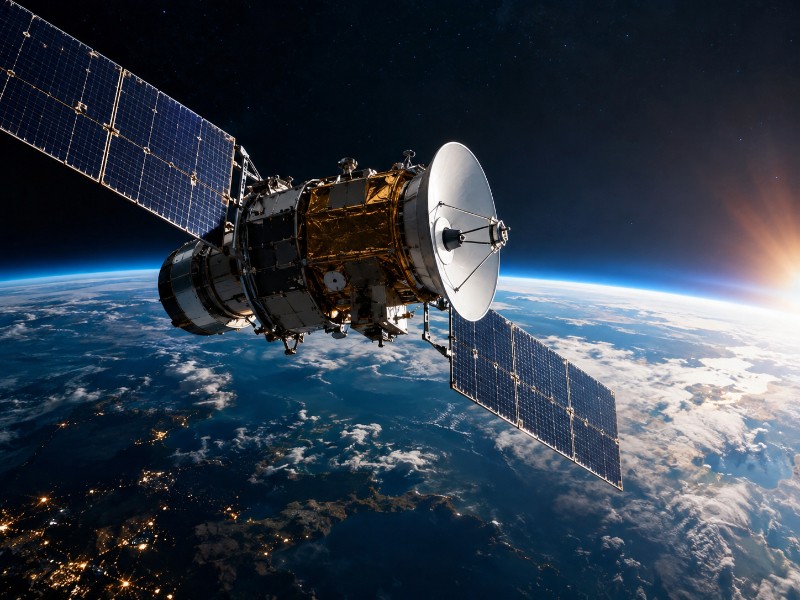
US Air Force Secretary Troy Meink disclosed the annual Air, Space and Cyber Conference at National Harbour in Maryland, saying an “on-orbit” weapon was necessary to protect US forces against emerging threats.
The US Space Force did not disclose the specific type of weapon, but said the capability is part of its broader mission to establish “space control”.
US reveals on-orbit weapon capability
Meink's remarks marked a significant public acknowledgement of an offensive US capability in space.
While Washington has long developed military systems designed to protect satellites and counter threats in orbit, the latest comments explicitly referred to weapons already deployed in orbit.
The Space Force said the systems were intended to enable the United States to respond to hostile actions against its forces and space assets.
“The US has on-orbit space control weapons capable of defending the Joint Force against hostile adversary action,” a Space Force spokesperson said.
The spokesperson did not provide details about the number, location or nature of the weapons.
The Space Force explained that “space control” covers missions designed to contest and control the space domain using both kinetic and non-kinetic capabilities.
“Space control encapsulates the mission areas required to contest and control the space domain — employing kinetic and non-kinetic means to affect adversary capabilities,” it said.
The agency added that “these capabilities can be employed for offensive and defensive purposes.”
China, Russia in US focus
The disclosure comes as Washington increasingly treats space as a potential battlefield involving the United States and its major strategic competitors, particularly China and Russia.
US officials have repeatedly warned that adversaries are developing systems capable of disrupting, degrading or destroying American space capabilities.
New Space Force Chief of Space Operations Gen. Douglas Schiess said earlier this month that potential adversaries were advancing their efforts to interfere with US space systems.
“Every day, our potential adversaries advance their efforts to disrupt, degrade or destroy our space capabilities and they try to add to their own capacity to exploit space to their advantage. We cannot — we will not — let that happen,” Schiess said.
The Space Force describes China as developing and operating space and counterspace capabilities as part of its military modernisation strategy.
It has also characterised Russia as viewing space as a warfighting domain and considering control of space an important factor in future conflicts.
Golden Dome drives space push
The announcement comes as the Trump administration accelerates work on its proposed Golden Dome missile defence system, which is intended to protect the United States from missiles and other airborne threats.
The wider US military space programme includes missile warning, tracking, communications, surveillance and space-domain awareness capabilities.
The Space Force recently announced progress on a resilient missile-warning programme designed to improve global missile tracking and provide additional battlespace awareness for US forces and allies.
The programme's first two Epoch 2 orbital planes have moved through a critical design review.
The United States is also expanding its ability to monitor activity around geostationary orbit.
The Space Force recently selected Lake Kickapoo in Texas as the preferred location for the third and final site of its Deep Space Advanced Radar Capability network, which it is developing with the United Kingdom and Australia.
Space militarisation dates back decades
Military competition in space is not new.
The US and Soviet Union began exploring military uses of space during the Cold War, shortly after the Soviet Union launched Sputnik in 1957.
The development of anti-satellite technologies and other counterspace capabilities has continued since then, with major powers seeking ways to protect their own satellites while potentially disrupting an adversary's space infrastructure.
Satellites have become central to military communications, navigation, intelligence gathering, surveillance and missile warning, making them increasingly important to modern warfare.
What the Outer Space Treaty says
The 1967 Outer Space Treaty established the principal international legal framework governing activities in space.
The treaty prohibits states from placing nuclear weapons or other weapons of mass destruction in orbit around Earth, installing such weapons on celestial bodies or stationing them in outer space by other means.
However, the treaty does not impose a blanket ban on all military activities or conventional weapons in space.
Military personnel and equipment can be used for peaceful purposes, while the treaty specifically restricts weapons of mass destruction and certain military activities on the Moon and other celestial bodies.
The distinction has allowed major powers to develop and deploy a range of military and counterspace technologies without necessarily violating the treaty's specific prohibitions.
US space capabilities expanding
The latest disclosure comes alongside a broader expansion of American space capabilities.
The Space Force has been strengthening satellite communications, missile warning and space surveillance systems.
Earlier this month, the United States and 10 international partners also signed an updated agreement supporting the production and operation of the WGS-12 military communications satellite.
The participating countries include the UK, Canada, Australia-linked partners and several European allies.