
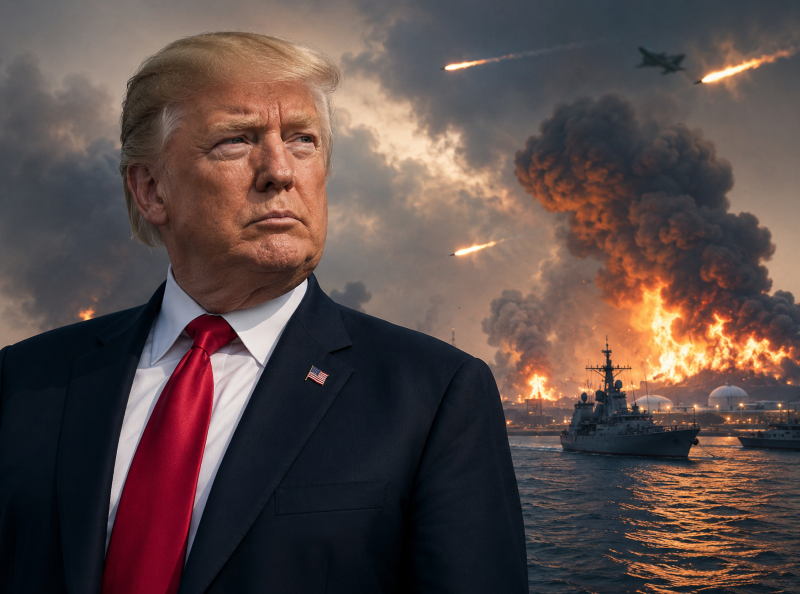
The latest US operation came hours after Iran's Revolutionary Guards announced that commercial shipping through the strategic waterway had been suspended following an encounter with a foreign vessel that it accused of ignoring military instructions.
Iran closes world's key oil corridor
Iran's Revolutionary Guards said they fired a warning shot at a vessel taking what they described as an "unauthorised route" through the Strait of Hormuz.
According to a statement carried by state news agency IRNA, several ships allegedly ignored repeated warnings to alter course.
"One vessel was struck by a warning shot and brought to a stop," the Guards said.
The force later declared that the Strait of Hormuz would remain closed "until further notice" and "until the end of American interventions in this region", warning that no ships would be allowed to transit the vital waterway.
Iran also warned that any retaliation would invite a "severe response".
US launches third round of strikes
Shortly after Tehran's announcement, the US launched its third round of military strikes against Iran this week.
The US Central Command (CENTCOM) said Iran had "blatantly attacked" a Cyprus-flagged container ship transiting the Strait of Hormuz.
According to CENTCOM, one civilian crew member is missing, while the vessel suffered a major onboard fire and extensive engine room damage, rendering it unable to continue its voyage.
The strikes began at 7:15 pm Saturday (2315 GMT) under the direction of President Donald Trump.
"Iran was provided yet another opportunity to demonstrate adherence to the Memorandum of Understanding after being held accountable for earlier attacks on commercial vessels but has again failed," CENTCOM said.
At 7:15 p.m. ET today, U.S. Central Command forces began launching the third round of strikes this week against Iran after Islamic Revolutionary Guard Corps forces blatantly attacked M/V GFS Galaxy, a Cyprus-flagged container ship transiting the Strait of Hormuz. A civilian crew…
— U.S. Central Command (@CENTCOM) July 11, 2026
"In response, the United States is imposing a heavy cost by continuing to degrade Iran's ability to attack civilian mariners and commercial ships freely transiting the strait."
US Defence Secretary Pete Hegseth also reacted sharply, writing on X: "Iran made a poor choice. Now they pay."
At 7:15 p.m. ET today, U.S. Central Command forces began launching the third round of strikes this week against Iran after Islamic Revolutionary Guard Corps forces blatantly attacked M/V GFS Galaxy, a Cyprus-flagged container ship transiting the Strait of Hormuz. A civilian crew…
— U.S. Central Command (@CENTCOM) July 11, 2026
Explosions rock southern Iran
Iranian state media reported explosions across several strategic locations along the country's southern coastline following the US strikes.
Blasts were reported in the energy hubs of Bushehr and Asalouyeh, as well as the port cities of Bandar Abbas and Bandar-e Dayyer.
Explosions were also heard in Sirik, located near the Strait of Hormuz.
Missile alerts across Gulf states
The conflict quickly spilled across the Gulf, prompting missile and drone alerts in several neighbouring countries.
The United Arab Emirates said its air defence systems were intercepting missile and drone threats, while Bahrain activated air raid sirens and urged residents to move to the nearest safe shelter.
Explosions were also reported in Qatar, where authorities issued missile alerts. The exact cause of the blasts was not immediately clear.
Iran has repeatedly targeted Gulf nations hosting US military facilities since the conflict erupted on February 28.
Hormuz dispute threatens fragile peace efforts
The latest escalation casts fresh doubt on efforts to revive a diplomatic settlement between Washington and Tehran.
President Donald Trump and Iranian President Masoud Pezeshkian had signed a 14-point agreement on June 17 aimed at ending the conflict, including an immediate halt to military operations and a commitment to negotiate a permanent settlement within 60 days.
However, Trump declared on July 8 that the agreement was "over".
A major sticking point remains the future of the Strait of Hormuz — the world's most important oil transit route.
Iran insists it will retain control over maritime traffic through the strategic passage and has proposed charging transit fees, signalling an end to the era of unrestricted commercial navigation through the chokepoint.