
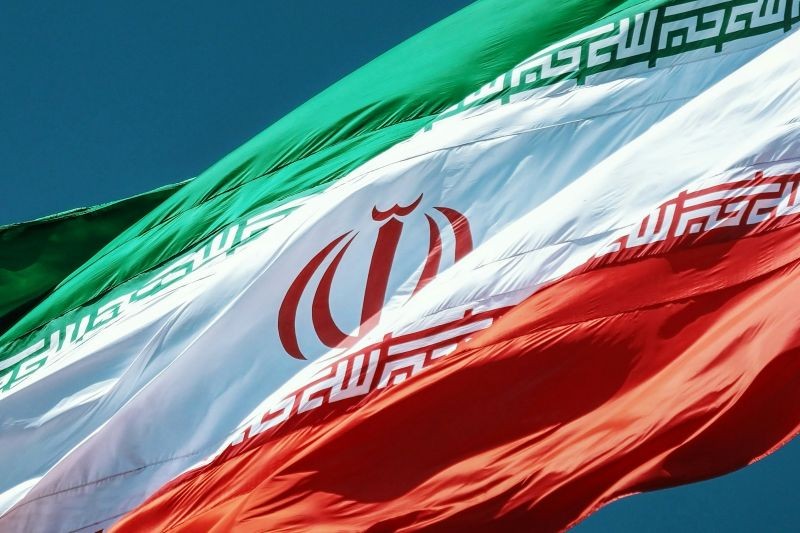
“As reported by the International Atomic Energy Agency [IAEA] Director General, Tehran continues to rapidly accelerate its production of highly enriched uranium,” the U.S. Mission to the United Nations said in a statement. “It is also the only country in the world without nuclear weapons producing highly enriched uranium, for which it has no credible peaceful purpose.”
The United States said Iran is “flagrantly” defying the U.N. Security Council and ignoring “the clear and consistent concerns" of both the council and the international community.
“The Council must be clear and united in addressing and condemning this brazen behavior,” the U.S. statement said.
Iran has denied for years that its nuclear pursuits are for military purposes. But starting in May 2019, it gradually stopped implementing its nuclear-related commitments under the 2015 nuclear deal, known as the Joint Comprehensive Plan of Action, or JCPOA, which provided Tehran with sanctions relief in exchange for limits on its nuclear program.
In February 2021, it stopped implementing its commitments altogether. As a result, the IAEA no longer conducts verification and monitoring activities related to the deal, and that has raised many questions about what Iran is doing.
The United States, along with Britain and France, which remain parties to the JCPOA, which the first Trump administration pulled out of, called a private meeting Wednesday of the U.N. Security Council to discuss Iran’s proliferation efforts. Council members Greece, Panama and South Korea also supported the call.
“We're seriously concerned about the latest IAEA report about Iran's production of highly enriched uranium,” British Deputy U.N. Ambassador James Kariuki told reporters.
“The director general reported last month that Iran has now produced 275 kilos of uranium enriched to 60% – that's way beyond anything needed for civilian use – and no other non-nuclear state has anything like that amount,” he said.
Kariuki said Britain will take any diplomatic measures necessary to prevent Iran from acquiring a nuclear weapon, including reimposing U.N. sanctions – a process known as snapback. Under the terms of the deal, previous U.N. sanctions can “snap back” if Tehran does not live up to its commitments.
The JCPOA is due to expire in October, which means the window could soon be closing for substantive negotiations.
Iran’s U.N. ambassador participated in the meeting, but his U.N. mission criticized it, saying on the social media platform X that “Washington openly seeks to weaponize the UNSC to escalate economic warfare against Iran. This dangerous abuse must be rejected to protect the Council’s credibility.” UNSC is shorthand for the U.N. Security Council.
Russia and China, who also are JCPOA signatories, are allies of Tehran.
China’s U.N. ambassador told reporters that the nuclear issue is being dealt with in Vienna at the IAEA and that Beijing was not supportive of Wednesday’s council meeting. Fu Cong blamed the Trump administration for disrupting the JCPOA in the first place by withdrawing in 2017, but at the same time he said China hopes there can be a new deal before October’s expiration.
“Putting maximum pressure on a certain country is not going to achieve the goal,” he added.
Fu noted that China will convene a meeting in Beijing with Iran and Russia on Friday, to try to facilitate a possible deal to stabilize the situation. It will be chaired by Executive Vice Foreign Minister Ma Zhaoxu, and Russian Deputy Foreign Minister Ryabkov Sergey Alexeevich and Iranian Deputy Foreign Minister Kazem Gharibabadi are expected to attend.