
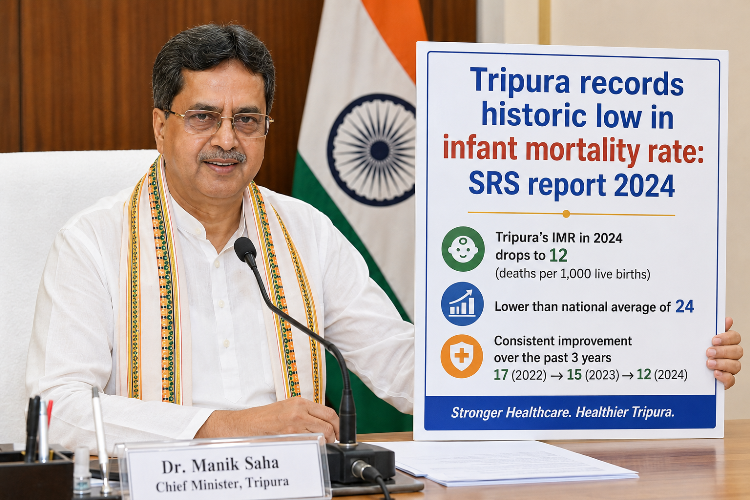
Tripura has achieved a significant milestone in the healthcare sector by recording the lowest-ever Infant Mortality Rate (IMR) in the state’s history, according to the Sample Registration System (SRS) Bulletin 2024 published by the Registrar General of India in May 2026.
As per the report, Tripura’s Infant Mortality Rate has dropped to 12 deaths per 1,000 live births in 2024, which is substantially lower than the national average of 24. The state has shown consistent improvement over the past three years, reducing the IMR from 17 in 2022 to 15 in 2023, and further down to 12 in 2024. In comparison, the national IMR stood at 26 in 2022, 25 in 2023, and 24 in 2024.
The report also highlights that neighbouring Northeastern states recorded comparatively higher IMR figures, with Assam at 29, Meghalaya at 31, and Arunachal Pradesh at 17.
Chief Minister Dr Manik Saha in a Facebook message said that “Sustained improvements in maternal and child health services, institutional deliveries, SNCU/NBSU strengthening, immunization coverage, and community-based health interventions have contributed to this achievement. I would like to thank Hon’ble Prime Minister Shri Narendra Modi Ji and Union Health Minister Shri JP Nadda Ji for supporting our endeavours in improving health services in Tripura State”.
The Chief Minister credited the success to the dedicated efforts of healthcare workers and the state Health and Family Welfare Department in strengthening prenatal and postnatal care, child immunization, nutrition management, and hospital-based delivery services across the state.
The state government also expressed gratitude to Prime Minister Narendra Modi and Union Health Minister J. P. Nadda for their continued support in improving healthcare infrastructure and services in Tripura.
While, in rural areas of Tripura, the IMR currently stands at 14 against the national rural average of 27, while urban areas in the state recorded an IMR of 7 compared to the national urban average of 17. Notably, in 2018, Tripura’s IMR was 24 overall, with rural areas reporting 32 and urban areas 20 deaths per 1,000 live births. The sharp decline over the years reflects substantial progress in the healthcare sector.
The state government attributed this achievement to continuous improvements in maternal and child healthcare services, institutional deliveries, strengthening of Special Newborn Care Units (SNCU) and Newborn Stabilization Units (NBSU), expanded immunization coverage, and community-based healthcare interventions.
The report further noted that Tripura’s birth rate stands at 15 per 1,000 population, lower than the national average of 18.3. The death rate in the state is also lower at 5.9 compared to the national average of 6.4. Similarly, the natural growth rate in Tripura is 9.1, below the national average of 11.9.